OpenArt AI Review 2026 — Honest Deep Dive | TechScribe.in
Image & Design AI
OpenArt AI logo
Honest Deep Dive · The Visual Creation Layer

OpenArt AI

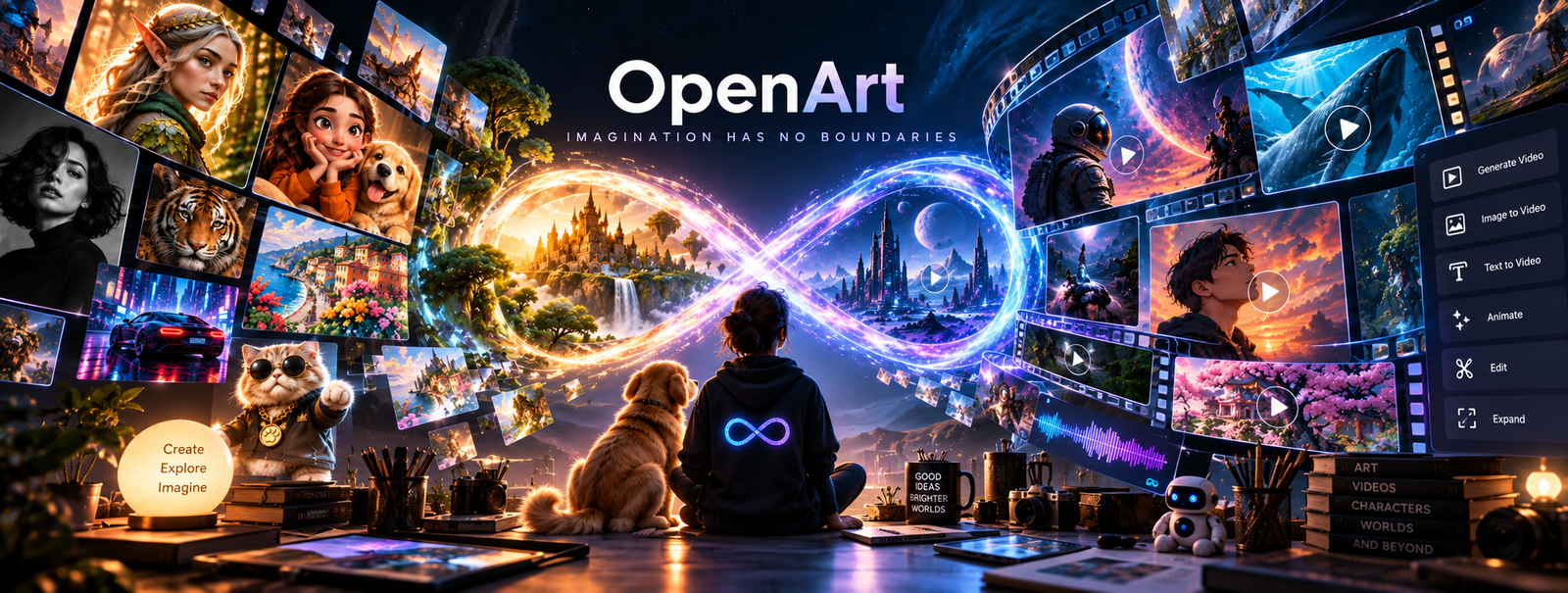
Generate images and short-form videos with creative speed and structural control — using 100+ models, ControlNet guidance, and custom LoRA training in a single workspace.

What is OpenArt AI?

OpenArt AI is a controlled visual creation engine designed for users who have outgrown prompt boxes. It runs 100+ AI models (FLUX, DALL-E 3, Stable Diffusion, Ideogram V3) through a unified browser workspace. It integrates ControlNet to enforce structural guidance — pose, layout, depth — and custom LoRA training to ensure visual outputs carry a consistent brand identity. A production-first workflow that rewards direction over simple discovery. Not a single-model generator. A complete visual production platform.

The bridge between prompting and precision —
structure control, not just style.

Most AI image tools are black boxes. You type a prompt, the model interprets it however it chooses, and you iterate until something close to what you intended appears. The entire surface area of your control is word choice. You are not directing. You are hoping.

OpenArt is built on a fundamentally different premise. It gives you control over structure — not just style. By integrating ControlNet alongside prompt generation, you provide the bones of the composition — a pose skeleton, a sketch, a depth map — and the prompt provides the visual skin. The model generates within your structure, not around it.

The comparison that clarifies the positioning: Midjourney gives you vibe control. OpenArt gives you structure control. For professional workflows, predictability is the only metric that actually matters. A beautiful image you cannot reproduce consistently is not a production asset. A controllable image you can reproduce at will is the foundation of a visual supply chain.

The 100+ model access compounds this structural advantage. FLUX, DALL-E 3, Stable Diffusion variants, Ideogram V3, community fine-tunes — all accessible from a single subscription with a single click. No separate accounts. No platform switching. No credential management. And when consistent output across a content series is the requirement, custom LoRA training locks in your visual identity at the model level before you generate a single asset.

"Midjourney gives you vibe control. OpenArt gives you structure control. For professional workflows, predictability is the only metric that matters."

From prompting to directing —
the shift arrives faster than you expect.

The first session with OpenArt does not feel like using a typical AI image tool. You enter a prompt. A strong image appears. You are about to move on — and then you notice the controls sitting beside the canvas. Model selector. ControlNet. Image guidance. Character 2.0. LoRA training interface.

You upload a rough sketch as a structural constraint. The AI fills in the detail while respecting your composition. You switch models — FLUX for photorealism, a community fine-tune for illustration, Ideogram V3 for text-in-image. The aesthetic shifts completely. The structural intent stays intact.

What the first session reveals
  • 100+ models available — switch aesthetic registers without leaving the platform
  • Upload a rough sketch as structural constraint — the AI fills in detail within your composition
  • Feed an OpenPose skeleton to control human figure anatomy precisely
  • Use depth maps to define spatial relationships between foreground and background
  • Character 2.0 — consistent character identity from a single reference image
  • LoRA training — 15 minutes, your own visual style locked in at model level

The realization that arrives: you are not just generating — you are directing. The second revelation comes at the LoRA training interface. You upload 20 reference images of your brand aesthetic. The model trains in 15 minutes. Your next generation inherits your visual identity rather than the model's default. The generic AI look — the visual sameness that makes AI content instantly recognizable and forgettable — is solved at the model level, not at the prompt level. That is a fundamental shift in how you think about AI image production.

OpenArt turns you from a prompter into a visual director. That shift is what separates a generation tool from a production workflow.

Not model quality.
Solving the generic AI look — at model level.

Most reviews of OpenArt evaluate the quality of individual image outputs. That framing misses the actual differentiator by a significant margin.

The real story is LoRA (Low-Rank Adaptation) training combined with ControlNet structure guidance. These two capabilities operate on different axes and together they give you something no other tool in this category offers at this price point.

LoRA Training — the brand identity layer: Without custom model training, AI-generated content is always an average of the model's training data. With LoRA, your outputs carry your specific aesthetic — your colour palette, your mood, your brand identity — applied consistently across every generation. Train on 20 carefully curated images of your brand's visual style. From that point forward, every image inherits your baseline before the prompt even runs. You bypass the generic AI look entirely — not by prompting harder, but by operating at the model level.

ControlNet — the composition layer: OpenPose for human figures, sketch-to-image for layout direction, depth maps for spatial relationships, Canny edge detection for structural reference. You operate two control axes simultaneously — prompt for semantic content and aesthetic register, ControlNet for structural composition. The output lands at their intersection. This is direction, not generation.

What ControlNet actually gives you
  • OpenPose — constrain human figure anatomy to match a reference skeleton exactly
  • Sketch-to-image — rough composition direction rendered into fully detailed visual output
  • Depth maps — define spatial relationships between foreground, subject, and background
  • Canny edge detection — structural reference from an existing image, style applied separately
  • Result — a composition that matches your intent, not what the model defaulted to

Core Truth: OpenArt optimises for controlled, consistent, production-usable output — not for the most impressive single image from a cold prompt. If you need one remarkable image with no consistency requirements, tools with higher single-shot aesthetic ceilings exist. If you need a scalable visual supply chain with brand identity baked in and compositional precision built into every generation, OpenArt is where that capability lives — and the gap versus alternatives is significant.

The 6 pillars of
controlled visual creation

🎛️
Prompt + ControlNet — two axes, one directed output

The prompt controls style and semantic content. ControlNet constrains structure — pose, layout, depth, edges. The model generates within the intersection of both constraints simultaneously. This is what separates direction from generation and makes professional visual workflows repeatable rather than aspirational.

🧬
Custom LoRA Training — your brand at model level

Upload 20 reference images, train in 15 minutes, inherit your aesthetic in every subsequent generation. The generic AI look is solved before you prompt. For content creators and marketers building scalable visual identity, this is the capability that separates OpenArt from every single-model generator in the category.

🔄
100+ Models — one workspace, every aesthetic register

FLUX, DALL-E 3, Stable Diffusion variants, Ideogram V3, and hundreds of community fine-tunes — all from a single subscription. Switch between photorealistic, illustrated, anime-style, and graphic outputs without changing platforms or managing separate credentials. The breadth of model access is unmatched in this price range.

👤
Character 2.0 — consistent identity across unlimited scenes

Train the system on a character from a single reference image. Generate that character across unlimited scenes, poses, and environments without visual drift between outputs. Foundational for content series, storytelling projects, and branded character assets that must look like the same character across every piece of content.

🎬
Short-Form Video — social-ready motion assets

Animate stills, generate motion loops, and create scroll-stopping video assets for Instagram Reels and TikTok directly from the same platform. Purpose-built for social media motion content — not cinematic production. The mental model: you are creating motion assets for feeds, not sequences for films.

🌐
Browser-Based, Zero Setup — no Discord, no GPU

Every capability — ControlNet, LoRA training, video generation, model switching, character training — runs in a browser tab. No Discord. No GPU required. No local installation. Accessible for non-technical creators from day one, deep enough for professional creative workflows from day five onwards.

The learning curve and production reality —
named honestly.

📈
The ControlNet Learning Curve

ControlNet requires several sessions to use effectively. You must learn which control type fits your specific goal — OpenPose for human figures, Canny edges for structural reference, depth maps for spatial layout, sketch-to-image for composition direction. New users who jump to ControlNet without building prompt fluency first find the outputs confusing. Build the foundation before adding the precision layer.

🎨
The Production Gap — outputs need a final pass

OpenArt outputs are production-capable — high enough quality for commercial use in most contexts. They are not production-finished. For high-visibility placements — print, premium advertising, client deliverables where visual precision is critical — the generated output is typically the strong starting point that benefits from a brief editorial refinement pass before final use.

🔁
Consistency Without LoRA Is Limited

Without LoRA training, output consistency across a series of generations is inherently limited. Character appearances drift. Brand aesthetics vary. This is a diffusion model characteristic — not an OpenArt-specific problem. Character 2.0 offers a faster starting point, though LoRA delivers substantially stronger brand-level consistency for serious production requirements.

💳
Credit System — budget before you build

OpenArt uses a credit-based pricing model. Different models consume different credit volumes — premium models and video generation are significantly more credit-intensive than standard image generation. LoRA training also consumes credits. Budget your session scope before starting complex builds, especially on Essential or lower plans. Unexpected credit exhaustion mid-session is a common friction point for new users.

⚖️
Commercial Rights Start at Advanced Tier

Free and Essential plan users cannot legally use generated images for client work or commercial projects. Commercial rights begin at the Advanced tier (approximately $14.50/month annual). If you are building a content business or producing assets for clients, verify your plan includes commercial rights before generating at volume — this is a frequently missed detail that creates legal exposure.

🧠
The Correct Mental Model

OpenArt is the starting and shaping layer of a visual content workflow — not the final editor. It generates and structures. You refine and apply. Treat it as a controlled creation engine that produces strong directed starting points. The platform rewards structured workflows: define your LoRA first, your ControlNet constraints second, then generate. That sequence produces dramatically better results than cold prompting alone.

Do NOT use OpenArt AI as your primary tool if you
  • Want the simplest prompt-and-generate experience with no learning investment — use Krea AI
  • Need crisp, readable text inside every image — use Ideogram 2.0
  • Need professional e-commerce product photos at batch scale — use Photoroom
  • Want cinematic long-form video production — OpenArt's video layer is social-asset scope only
  • Will not invest the sessions required to develop ControlNet fluency — the core advantage is inaccessible without it

What you're
actually getting

Platform
Browser-based, cloud rendered

No installation. No Discord. No GPU required. Works on any modern browser. Every capability accessible from day one.

Model Range
100+ models — FLUX, DALL-E 3, SD, Ideogram V3

Switch between photorealistic, illustrated, anime, and graphic outputs with a single click. Community fine-tunes included. No separate subscriptions.

Structural Control
ControlNet — industry-leading

OpenPose, Canny, Depth, Sketch-to-Image. Enforces composition at the structural level. Directs the model rather than hoping it interprets correctly.

LoRA Training
Advanced — 15 minutes

Train on 15-20 reference images. Model variant inherits your aesthetic baseline. Solves the generic AI look at model level before prompting begins.

Character Consistency
Character 2.0 — single reference image

Consistent character identity across unlimited generations from one reference photo. Updated late 2025. Essential for content series and branded characters.

Video Capability
Short-form social scope

Motion loops, animated stills, social-ready Reels and TikTok assets. Not cinematic production scope. Purpose-built for feed content, not film sequences.

Learning Curve
Moderate — rewards investment

Prompt fluency accessible from day one. ControlNet requires several sessions. LoRA training is straightforward. The platform scales with your investment.

Pricing
Freemium — from $7/month

Free plan: 40 trial credits. Essential: ~$7/month annual. Advanced: ~$14.50/month (commercial rights). Credit-based consumption model.

What to expect
session by session

S1
Session One
You discover this is not a prompt box — it is a workspace.

You generate strong images from prompts and discover the model selector. Switching between FLUX photorealism and an illustrated fine-tune in a single click. You find ControlNet and run your first sketch-to-image generation. The realization arrives: this tool rewards structured intent. You end the session knowing you have accessed perhaps 20% of what the platform offers — and understanding that the other 80% rewards deliberate investment.

S3
Sessions Two to Three
ControlNet becomes a tool. LoRA training changes everything.

You develop prompt fluency across multiple models and begin adding ControlNet as a precision layer. You learn which control type serves which use case — OpenPose for human figures, sketch-to-image for layout intent. You run your first LoRA training session. The outputs carrying your trained model look immediately different — more consistent, more recognizably yours. The production workflow begins to take shape: LoRA baseline plus ControlNet structure plus prompt detail equals directed output.

S5+
Session Five Onwards
You operate as a visual director. The platform becomes invisible.

Model selector, ControlNet settings, and trained LoRA variants are part of a workflow — not a discovery process. You generate consistent visual assets across a content series in a single session. The gap between what you intend and what you receive is narrow enough to bridge with a brief refinement pass. OpenArt has become production infrastructure — not just a generation tool.

🎯
Pro tip: Before training a LoRA, curate your reference images carefully. Ten high-quality, compositionally consistent reference images will produce a better-trained model than thirty varied ones. Treat the curation step as the most important part of the LoRA workflow — the model learns exactly what you show it, not what you intend.

Three creators who will
get real value from this

🎨
The Content Creator Building Visual Identity
Consistent output at scale — not one-off generation

You produce social media content, affiliate site visuals, or marketing assets at volume and generic AI-generated images are no longer a differentiator — every competitor has access to the same tools. OpenArt's LoRA training gives you visual identity at the model level. Your outputs carry your aesthetic. They are recognizably yours in a way that cold-prompt generation can never replicate at scale.

📢
The Marketer Needing Controllable Compositions
Specific layout requirements — not creative exploration

You brief visual content against specific layout requirements — text placement zones, subject positioning, background depth for overlaid copy. ControlNet makes those requirements structural constraints rather than prompt suggestions. The composition lands where you directed it. For performance marketers producing ad creatives at volume, iterating aesthetics across a fixed structural template is a workflow transformation.

🏗️
The Affiliate and SEO Builder
Scalable differentiated visuals — not stock images

You build content sites and affiliate properties. You need visuals that do not look stock, do not look generic, and do not look like every other AI tool your competitors are using. LoRA training on a consistent visual character or brand aesthetic gives you a scalable visual supply chain differentiated at the model level. Combined with OpenArt's video layer for social traffic, this covers the full visual asset requirement.

📊
The OpenArt Threshold: Use OpenArt when you need both generation capability and structural control — when the output must match a specific composition, maintain character consistency across a series, or carry a trained visual identity. If you need a single strong image from a cold prompt with no consistency requirements, simpler tools with higher single-shot aesthetic ceilings exist and serve that need better.

If your needs point
in a different direction

Being honest about fit is what makes a recommendation worth trusting. Here is when a different tool will serve you better than OpenArt AI.

The verdict

OpenArt AI made a deliberate choice — control over randomness, workflow over novelty, consistency over occasional brilliance.

Everything reflects that: ControlNet structure guidance that constrains composition rather than hoping the model interprets the prompt correctly. LoRA training that locks in brand visual identity at the model level before a single generation runs. 100+ model access that makes aesthetic range a workflow tool rather than a platform decision. Character 2.0 that makes series production possible rather than aspirational. Browser-based zero-setup that removes the last remaining technical barrier without sacrificing depth.

It is not trying to be the simplest AI image generator. It is not competing on single-shot aesthetic ceiling. It is not the right tool for someone who wants to type a prompt and receive a finished image with no further investment.

It is trying to answer one question better than any tool in this category — how do you produce controlled, consistent, visually differentiated AI content at production scale?

The answer: stop prompting and start directing. Build your visual identity at the model level through LoRA training. Constrain your compositions through ControlNet. Switch models to change aesthetic register without changing platforms. Invest the sessions required to develop workflow fluency — because the return, measured in output consistency and production speed, is significant.

OpenArt AI is the Visual Creation Layer. It does not just generate visuals — it gives you control over how they are built, what they look like across a series, and whose aesthetic they carry. For creators for whom visual consistency is a competitive advantage, that control is what makes everything else possible.

Create Visuals With Control

Open OpenArt, select a model that matches your aesthetic register, and run your first ControlNet generation with a reference structure. Then train a LoRA on your brand aesthetic. Within two sessions you will understand whether this is the visual production workflow your content operation has been missing.

Affiliate link — we may earn a commission at no extra cost to you. Our review is always independent.

OpenArt AI logo Try OpenArt AI →

Back to Top
InVideo AIHeyGenDescriptFlikiPictoryCapCut ProVEED.ioVeo 3 / 3.1ElevenLabsMurf AIResemble.AISpeechifyAhrefsFraseSurfer SEORank MathDorikDurableMixoUseArticleEmergentKittlCanva AIAdobe ExpressPhotoroomKrea AIFotorTopaz Photo AIIdeogram 2.0Phot.AIOpenArt AILetsEnhanceSysteme.ioClickFunnelsGetResponseHubSpotKitJasperGrammarlyQuillBotWritesonicCopy.aiRytr