 Stable Diffusion
 Leonardo AI
 Canva AI
 Adobe Express
 Photoroom
 Krea AI
 Fotor
Fotor Topaz Photo AI
 Ideogram 2.0
 Phot.AI
 OpenArt AI
 NightCafe
 LetsEnhance
 Midjourney AI
 CHATGPT
 Magnific
Kittl workflow test
from an AI prompt to a print-ready apparel concept
The real test of Kittl isn't the AI image on its own — it's how fast an idea becomes a production-ready design. So instead of stopping at the generated artwork, we ran the whole workflow inside the editor: generate a vintage outdoor badge, remove its background, place it on a hoodie template, and assemble a front-and-back apparel presentation — start to finish, without leaving Kittl AI.
"Create a premium vintage outdoor t-shirt design. Main illustration: a majestic brown bear walking through a pine forest with snow-capped mountains and a rising sun in the background. Typography: large vintage lettering ADVENTURE AWAITS; smaller text 'Explore More • Wander Often • Est. 2027'. Style: retro National Park poster aesthetic inspired by classic American outdoor apparel — circular badge composition with bold typography integrated into the illustration, distressed screen-print texture, vector-style artwork, thick outlines, and a limited palette of forest green, burnt orange, cream, mustard yellow, and dark brown. Output: professional t-shirt graphic centered on a transparent background, print-ready, high contrast, suitable for premium apparel and screen printing. No mockup, no t-shirt, no person, no background scene."

What the editor generated from the prompt — a print-ready "Adventure Awaits" badge, ready for background removal and placement onto apparel.
The workflow, step by step
- Generated the vintage outdoor badge using ChatGPT Image 2 inside Kittl
- Removed the background with Kittl AI's built-in editing tools
- Placed the artwork onto a hoodie template
- Created a front-and-back apparel presentation (tech pack)
- Produced a presentation-ready concept entirely within the app
Before and after
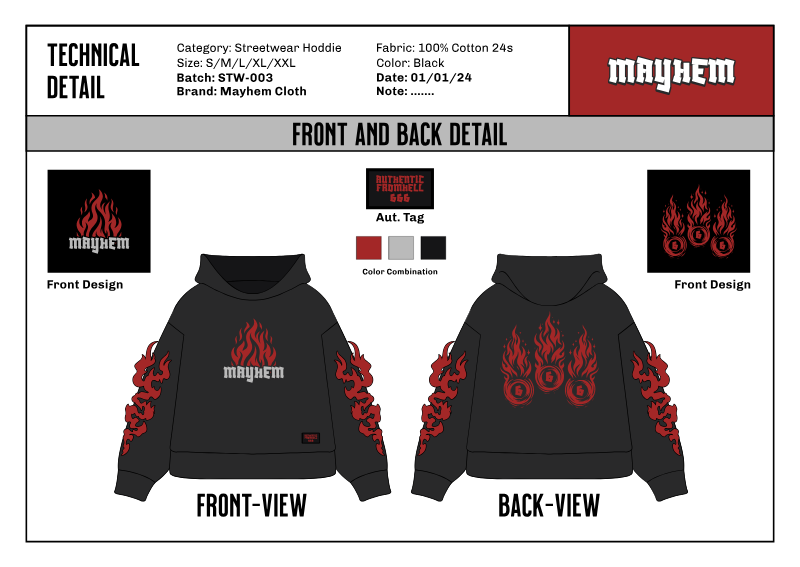
The front-and-back hoodie template we started from inside Kittl AI.
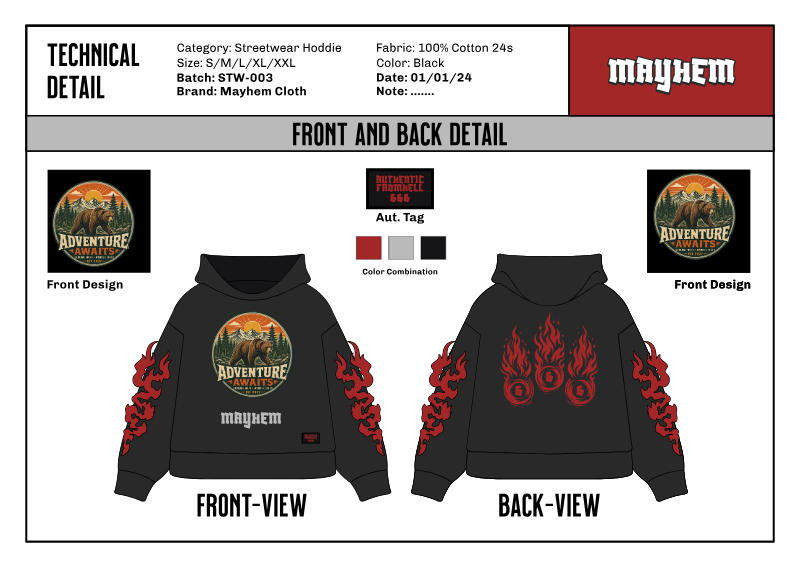
The AI-generated vintage badge, background removed, placed and assembled into a print-ready front/back apparel presentation.
Assessment. One of the tool's biggest strengths isn't simply AI image generation — it's how quickly you can transform an idea into a production-ready design. In this test, the badge was generated, cleaned up, placed onto a hoodie, and assembled into a front/back apparel presentation within minutes, all without leaving the editor. That integrated workflow is where Kittl provides value beyond the underlying image model.
Workflow scorecard
| Category | Score |
|---|---|
| AI Artwork | 9.5/10 |
| Typography | 9.5/10 |
| Editing Experience | 10/10 |
| Mockup Workflow | 9.5/10 |
| Ease of Use | 9.8/10 |
| Commercial Readiness | 9.0/10 |
| Overall Workflow | 9.6/10 |
- AI Artwork (9.5): the generated badge captured the requested vintage outdoor aesthetic with clean typography and a balanced composition suitable for apparel.
- Typography (9.5): the headline and supporting text were readable and well integrated into the design.
- Editing Experience (10): background removal, resizing, placement, and layout adjustments were all completed inside Kittl AI without needing external software.
- Mockup Workflow (9.5): converting the artwork into a hoodie presentation and a front/back tech pack was quick and intuitive.
- Ease of Use (9.8): the workflow was straightforward, requiring minimal manual effort to reach a polished result.
- Commercial Readiness (9.0): the final concept is suitable for showcasing to clients or using in print-on-demand, though a manufacturing-ready tech pack would still need additional production specifications.
The Composition Layer,
not the Blank Canvas.
Most design tools start with a blank canvas and infinite creative decisions. Canva gives you a general-purpose content creation environment. Adobe Express gives you brand templates. Figma gives you a professional design system — but one built for products, not promotion. The platform is asking a different question entirely. Not "what do you want to create?" but "how should this look — professionally?"
Every other tool hands you the canvas and the brush and expects you to figure out composition, hierarchy, spacing, and visual balance on your own. Kittl gives you structured visual aesthetics from the first click. Typography-first layouts. Merch-ready compositions. Vector-based AI graphics. Design systems that produce professional-looking results before you have made a single creative decision.
This is what Kittl AI is actually for. It is a composition acceleration layer for promotion — not a blank-canvas creative suite, not a UI design tool, not a general content platform. You are not being asked to design from zero. You are being asked to arrange, customize, and refine within a framework that already understands what professional visual hierarchy looks like.
"Kittl doesn't help you draw — it helps you compose."
You pick a direction —
and it arranges itself.
When you open the editor for the first time, the experience is structured around templates, not blank canvases. You start with a phrase, a style direction, or a use case — merch, poster, thumbnail, social graphic. Kittl generates a typographic layout with visual hierarchy already in place. Decorative styling. Spacing systems. Compositional balance. The structure is already there. Your job is to customize, not to construct.
- Template-first workflow that removes the blank canvas problem
- Typography layouts with built-in visual hierarchy
- AI-generated graphic elements in vector format
- Adjustable text, layout, and style controls
- Export options ready for print, merch, and digital use
Kittl AI assumes your goal is professional output — not creative exploration.
Not a design tool.
A typography engine.
Almost every review of the app compares it to Canva on feature breadth or evaluates it as a basic template generator for beginners. That framing misses what Kittl is actually doing. The product Kittl AI is building is a typography and composition system that makes non-designers look like they hired one.
Solves the typography problem. Most beginner graphics fail silently because the typography looks wrong. The tool pre-solves all of this by giving you layouts where the typography already works.
Produces vector-native, editable output. Unlike Midjourney where the AI's decision is final, Kittl gives you vector nodes you can move. Co-creation, not just generation. For merch and print-on-demand, this is a production requirement.
Creates instant perceived professionalism. Kittl AI generates compositions that signal design competence even when the creator has no design background. For merch sellers and creators, this translates directly into higher-converting graphics.
- Pre-built text hierarchy — no design theory required
- Spacing systems and visual balance from the first click
- Vector-native AI that stays editable after generation
- Print-ready SVG and PDF exports for POD platforms
The moments that make
this tool worth knowing
Pre-built text hierarchy, spacing systems, and visual balance that make layouts look professionally composed from the first click. No design theory required.
Built specifically for apparel graphics, poster layouts, and POD workflows. Vector-native exports are production-ready for Printful, Printify, and Redbubble.
Editable, scalable AI-generated graphic elements that maintain quality at any print size. Unlike locked raster outputs from image generators, these are assets you can continue to refine.
Attention-grabbing layouts optimized for YouTube thumbnails, social media graphics, and content creator assets. Hierarchy is built in, not improvised.
High-conversion visual trends — vintage, retro, bold typographic — executed through pre-built style systems. Strong for Etsy, merch, and affiliate creative.
Production-quality SVG, PDF, and PNG exports that move from design to print without quality degradation. The full workflow from concept to file is handled in one tool.
Preview a design on physical products — t-shirts, mugs, posters, tote bags — without leaving the platform. Seeing the artwork in context before export makes it far easier to judge scale, placement, and contrast for merch.
Kittl Video (launched 2026) animates what you've already designed — typography, vectors, and layouts — from a prompt. Supply a first and end frame and the AI fills the motion between them. Useful for logo animations and turning a static product mockup into a short animated showcase for social, Etsy, or Shopify.
The template library:
typography-first, merch-ready
Kittl AI's curated templates are the practical starting point for most projects. Rather than a broad, generic library, the templates are built typography-first — professionally composed layouts for apparel, posters, thumbnails, logos, and social graphics where the visual hierarchy, spacing, and font pairing are already resolved. You choose a direction and customize inside a system that already looks designed, drawing on a large library of fonts, illustrations, textures, and graphic assets.
T-shirt, hoodie, and print-on-demand layouts sized and composed for apparel. The vintage, retro, and bold-typographic styles that convert on Etsy and POD platforms are available as ready-to-customize templates.
Print-ready poster and flyer templates with production-quality export. Typography hierarchy is pre-built so headlines, subheads, and details stay balanced at large print sizes.
YouTube thumbnail and social-graphic templates with attention-first composition — readable text at small sizes and layouts optimized for the feed and the video grid.
Logo, badge, and branding templates for small businesses, creators, and emerging brands building a consistent brand identity — vector-native so they scale cleanly across print and digital.
High-conversion aesthetic systems — vintage revival, retro type, distressed textures — packaged as templates so non-designers can execute trend-driven looks without building them from scratch.
A portion of the template and asset library is free; premium templates, fonts, and assets unlock on paid plans. Customizing typography, layout, and textures is what separates your design from the default look everyone else starts from.
- Start from a thumbnail template (or a poster template resized to 1280×720)
- Customize typography using the editor's hierarchy presets — headline, subhead, and call-out text
- Add an AI-generated graphic or icon with the vector generator to match the video topic
- Check readability at small sizes using the spacing and alignment tools
- Export as a 1280×720 PNG at 72 DPI, keeping the file under 2MB for YouTube
Kittl AI Image Generator
and the token system explained
Kittl's AI features run on a token system. Every AI action — image generation, vector generation, video (Motion on Canvas), upscaling, or background removal — consumes tokens from your monthly allowance. The free plan includes a one-time allowance of 200 tokens; the Pro plan includes 2,000 tokens per month and the Expert plan 6,000 per month. Tokens reset each billing cycle and do not roll over, and add-on token packs are available if you run out mid-month. Knowing this upfront helps you budget AI generations against your design volume.
Generate custom raster images from a text prompt directly inside the editor — backgrounds, illustrations, and concept art that match your design without leaving the platform.
Produce editable vector graphics from a prompt, or convert an existing raster image into clean vector nodes. Essential for merch and print where designs must scale without quality loss.
Remove a background in one click, then use Edit Cutout to brush back any part the remover took away by mistake — finer control over the cutout without redoing it from scratch.
Upscale images to higher resolution so AI-generated or low-res source art holds up at print sizes — a production requirement for POD and large-format work.
Brush over a region, describe the change, and Kittl adds, erases, replaces, or updates just that part of the image — without regenerating the whole thing. Ideal for seasonal adaptations, fixing small flaws, or swapping a background for a mockup.
Describe what you want in plain words and Kittl AI's Agentic AI chooses the right model and generates variations, with a unified input for generating and remixing images into multiple design styles from a single starting point.
AI token allowance by plan
| Plan | AI tokens | Rollover | Add-on packs |
|---|---|---|---|
| Free | 200 one-time | No | — |
| Pro | 2,000 / month | No — resets each cycle | Available |
| Expert | 6,000 / month | No — resets each cycle | Available |
| Business | Custom | By agreement | Available |
Kittl Pricing and Plans:
what you get for your money
The app runs a free plan plus two main paid tiers and a quote-based team plan. The paid plans are billed per month, and the annual option is meaningfully cheaper than paying month to month. The jump most creators care about is from Free to Pro: that's where high-resolution and vector exports, a commercial license, and a real monthly token allowance unlock.
| Plan | Price | AI tokens | Storage | Best for |
|---|---|---|---|---|
| Free | $0 | 200 one-time | — | Trying the workflow; personal, low-res use |
| Pro | $12/mo billed annually ($15 monthly) | 2,000 / mo | 10 GB | Merch creators and POD sellers who need commercial rights |
| Expert | $26/mo billed annually ($35 monthly) | 6,000 / mo | 100 GB | High-volume creators and freelancers delivering client work |
| Business | Custom quote | Custom | Custom | Teams and agencies needing collaboration and enhanced licensing |
- Up to 5 projects and a one-time 200-token AI allowance
- Exports capped at roughly 800px / 72 DPI — too low for quality print or merch
- Personal use only — no commercial license, so you can't sell designs made on the free plan
- Premium templates, fonts, and assets stay locked until you upgrade
Kittl Licensing and Commercial Use
for merch creators
Licensing is the detail that decides whether Kittl works for a selling business, and it's tied to your plan. The paid plans include a commercial license that covers exactly the use cases merch and POD creators need — but with a reproduction cap that high-volume sellers should understand before committing.
| Plan | License | What you can do |
|---|---|---|
| Free | Personal use only | No commercial rights — designs can't be sold or used for client work. |
| Pro & Expert | Commercial license | Sell designs on merch, print-on-demand, packaging, marketing, and digital media — up to 500,000 printed reproductions per design. |
| Business | Enhanced license | Wider reach beyond the 500,000-copy limit, for teams and high-volume merchants. |
- The license covers templates, AI-generated assets, and fonts used inside your Kittl AI designs
- The 500,000-reproduction cap covers most individual sellers and small businesses; very high-volume merchants may need the Business plan
- You can keep using and selling designs commercially after a Pro or Expert subscription ends, as long as your the tool account stays open
Kittl vs Canva
for print-on-demand
The most common question about Kittl is how it stacks up against Canva. For general content and volume templates, Canva is the broader tool. But for print-on-demand and merch specifically — where export quality, licensing, and typography decide whether a design sells — the trade-offs run in Kittl AI's favour. Here's the head-to-head on the dimensions that matter for POD.
| For print-on-demand | The platform | Canva |
|---|---|---|
| Export format | Vector-native SVG, PDF, PNG — scales to any print size | Primarily PNG/JPG raster; SVG only on higher tiers |
| Typography | Pre-built hierarchy and pairings — merch type looks composed by default | Flexible text tools, but composition is on you |
| Templates | Typography-first, apparel/poster focused | Enormous general library; less POD-specific |
| Commercial license | Clear commercial rights up to 500,000 reproductions on paid plans | Tiered licensing; some assets carry extra restrictions for resale |
| Workflow speed for merch | Fast — pick a merch template, customize type, export print-ready | Fast for social; more manual setup for print-ready merch |
| Best for | Merch, POD, posters, thumbnails, typographic design | High-volume social content and general team design |
Choose Kittl when you're selling what you design — vector exports and a clear commercial license make it merch-ready. Choose Canva when you need volume and breadth of general templates across a team. For a POD business, Kittl AI's export quality and licensing are the deciding factors.
Kittl vs Adobe Express
for small business brand management
For brand and marketing work, the choice is often Kittl AI against Adobe Express. Adobe Express leans on a broad template library and a mature brand-kit system inside Adobe's ecosystem. The editor leans on typography-first templates and vector-native export. Here's how they compare for a small business managing its own brand.
| For small business branding | Kittl | Adobe Express |
|---|---|---|
| Brand assets | Brand-consistent templates, fonts, and reusable vector assets | Dedicated brand kit — logos, colours, and fonts stored centrally |
| Templates | Typography-first, merch and promotion focused | Very broad general library across social, print, and web |
| Collaboration | Real-time on the Business plan | Team features across Adobe's ecosystem |
| Export | Vector-native SVG, PDF, PNG — scales for print | PDF and PNG; strong for social and quick digital |
| Pricing | Free plan; Pro from $12/mo billed annually | Free plan; lower monthly entry on Premium — check live pricing |
| Best for | Merch, POD, and typography-led brand promotion | Broad marketing assets inside the Adobe ecosystem |
Pick Adobe Express if you want a central brand kit and the widest template range for general marketing. Pick Kittl AI if your brand leans on strong typography and you need vector-native, print-ready output for merch and promotion.
G2 Community Reviews
From 32 verified users
Kittl AI holds a 4.8 / 5 rating on G2 from 32 verified reviews. The praise centres on ease of use and template quality; the recurring complaint is the AI token system and occasional instability. Here's the honest split.
4.8 / 5 — ★★★★★ from 32 verified reviews.
- Ease of use — reviewers repeatedly say beginners and pros alike create professional-quality graphics quickly.
- Template and asset library — high-quality, ready-to-use templates, fonts, and illustrations that make non-designers look designed.
- Relevant AI tools — image generation, vector generation, vectorizing, upscaling, and background removal are called out as genuinely useful for production work.
- Quality tutorials — the learning material gets specific praise for getting people productive fast.
- Real-time collaboration — teams value working on the same project together on the Business tier.
- Token system — the most common complaint; AI generations stop once tokens run out, and some users report credits deducted on failed generations.
- Occasional instability — glitches and unexpected sign-outs during work are mentioned by several reviewers.
- AI variety — requests for more art styles and a wider element library for greater creative range.
- Learning curve beyond basics — the tool is easy to start but takes effort to master advanced control.
- No mobile app — The app is web-only and depends on a stable internet connection.
This summary is based on 32 verified G2 reviews. Visit G2 for the most current user feedback and detailed breakdowns.
Kittl in action
official walkthroughs worth watching
Two demos from Kittl's official channel show the workflow in practice — turning a single sketch into a set of sellable POD designs, and using the newer AI editing tools for precise image fixes.
Kittl AI's walkthrough of turning one sketch into ten print-on-demand product designs — the versatility-and-scaling workflow that fits current merch trends around bold, adaptable, hand-drawn styles.
A demo of Edit Area (AI inpainting) — adding, erasing, or replacing parts of an image with a brush and prompt — and Edit Cutout, which restores anything the background remover took away by mistake.
A few things worth
understanding upfront
Kittl is structured around templates and composition systems. If you need to build something from a completely original concept with no constraints, the tool will feel limiting. That constraint is also the product.
The template trap is real. If you use Kittl AI without customizing typography and layouts, your graphics start looking like the default Etsy aesthetic. Push further than the starting point.
Most users do not realize the platform's SVG export capability until they need to scale a design for large-format print. For print-on-demand businesses, this is a production requirement.
Kittl excels at composition. It is not built for painting, sketching, detailed character illustration, or cinematic visual storytelling. Use it for layout-heavy graphics.
What it actually
looks like under the hood
No installation required. Works entirely in browser.
Composition-focused, not general illustration.
Structured starting points eliminate blank canvas friction.
Print-production ready. SVG for scalable merch assets.
Not locked raster output. AI is co-creation, not final decision.
Co-creation, not just generation. You refine after AI builds structure.
Printful, Printify, Redbubble exports supported.
Fast onboarding. Composition handled for you.
Tokens power image gen, vector gen, upscaling, and background removal. Reset each cycle, no rollover; add-on packs available.
Upload storage for your own assets and files scales with the plan. Business is custom.
Multiple designers can work on the same project together, useful for agencies and content teams.
Included on Pro and Expert; Business adds an enhanced license beyond the 500k cap. Free plan is personal use only.
Region-based image editing and prompt-driven variations without regenerating the whole design.
Preview designs on apparel and products before export — no separate mockup tool needed.
Prompt-based animation of existing designs with first/end-frame control. Consumes AI tokens like other generative features.
What to expect
session by session
The hardest part of graphic design — composition — has already been handled for you. First session ends with a finished, professional-looking graphic.
You discover that AI gives you a starting structure, not a final output — and vector nodes are yours to move. Customization separates templated from designed.
Experienced users develop a workflow: concept and layout in Kittl, illustration sourced elsewhere. Kittl is the typography and promotion engine at the center of a faster creative process.
Three creators who will
get real value from this
You need graphics that look professionally designed and export print-ready for Printful, Printify, or Redbubble. Kittl gives you vector-native, editable compositions that scale to any print size without quality loss.
You produce high volumes of visual content and need graphics that look designed without a designer on payroll. Kittl handles thumbnail composition, social card layouts, and quote graphics faster than any alternative.
You know what you want to communicate but not how to make it look professional. Kittl closes that gap. The composition systems give you access to professional visual hierarchy without design software expertise.
Who should
look elsewhere
Being honest about fit is what makes a recommendation worth trusting. Here is when another tool will serve you better.
Kittl Review:
Frequently Asked Questions
About this review
This review was researched and written by the TechScribe editorial team. It combines hands-on testing — the workflow test above ran a real prompt from AI generation through background removal, mockup placement, and a print-ready apparel concept, all inside Kittl AI — with the platform's own product documentation, live pricing, and verified user feedback from G2 (4.8 out of 5 across 32 reviews at the time of writing). Where Kittl has real limits — the token system, no mobile app, and shallow illustration depth — we say so plainly, and we update this page as Kittl AI's features and pricing change.
TechScribe publishes hands-on, no-hype reviews of AI and design tools. This page contains affiliate links: if you sign up through them we may earn a commission at no extra cost to you, which never affects our rating or what we recommend.
The verdict
The editor made a deliberate choice — prioritize composition over complexity.
That choice is visible in everything the product does. The template-first workflow that removes the blank canvas problem before you encounter it. The typography systems that give non-designers access to professional visual hierarchy. The vector-native, editable output pipeline that makes the AI a collaborator instead of a decision-maker.
It is not trying to compete with Illustrator on illustration depth. It is not trying to match Figma on collaborative design systems. It is trying to answer one question better than any other tool in the category — how do I produce graphics that look professionally composed without spending hours learning design software or hiring a designer?
Kittl does not improve your ideas. It improves how your ideas look. Use it when you need graphics that look designed, not generated. Use it when your concept is strong but your layout is weak. Kittl AI won't make you a designer. It will make people think you hired one.
Try Kittl for yourself
Explore the Typography Engine — see if composition-first design changes how you create merch, thumbnails, and social graphics.
 Try the app →