AI Copywriting ToolsJasperJasperGrammarlyGrammarlyQuillBotQuillBotWritesonicWritesonicCopy.aiCopy.aiRytrRytrWordtuneWordtuneHemingway EditorHemingway Editor Copywriting AI
Jasper
Honest Deep Dive

Jasper

The brand intelligence layer that turns briefs into on-brand campaigns — without the rewrite cycles.

Long-form
Brand
Team
What is Jasper?

Jasper is a brand intelligence layer for marketing teams. It does not hand you a blank box and say start prompting. It replaces the blank box with a brand box — locking every output inside your defined voice, tone, and positioning before a single word appears. The result is not just faster content. It is consistently on-brand content at scale.

The Strategist, not the Generator.
Brand box, not blank box.

Most AI writing tools hand you a blank box and say start prompting. That works — until it doesn't. Prompt fatigue is real, and it arrives faster than most people expect.

ChatGPT is the Generator — it produces content from whatever you ask. Jasper is the Strategist — it replaces the blank box with a brand box. You are not prompting randomly. You are executing inside a defined system: brand voice, tone, positioning, audience. Every output is constrained by that system before a single word appears.

That difference shapes everything. It is not built for one-off outputs or open-ended exploration. It is built for consistency across campaigns, teams, and channels — for organisations where the cost of going off-brand compounds with every piece of content that ships.

It doesn't just generate content. It aligns that content to the brand before the first word appears.

It asks for your brand
before it asks for your prompt.

When you open Jasper for the first time, it does not start with "what do you want to write?" It starts with brand voice, tone guidelines, audience definition, and use case. The system wants to know who you are before it helps you say anything.

What the first session looks like
  • A brand setup flow that captures tone, voice, and positioning
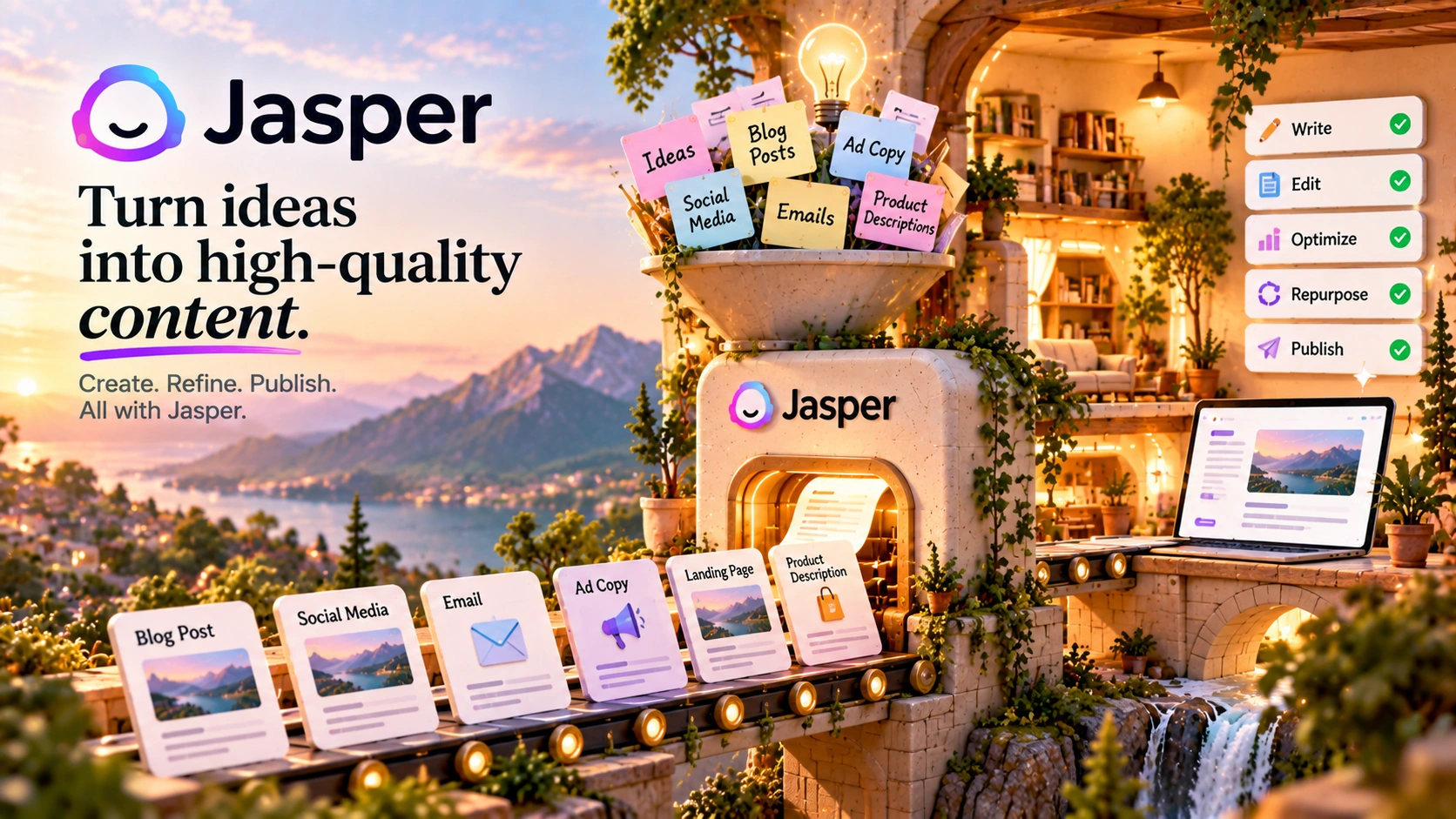
  • 50+ structured templates organised by use case — ads, blogs, emails, landing pages
  • Campaign-oriented inputs rather than open-ended prompt fields
  • Guided prompts that push you toward output structure before you type
  • Output that already sounds like the brand — not generic AI

It rewards operators who think in campaigns, not prompts. Arrive with a brief — not a blank idea.

This isn't built for one-off questions. It's built for campaigns. The difference shows up in the output quality at week three.

Jasper G2 Reviews
From 1,270 verified users

Jasper holds a 4.7/5 rating on G2 based on 1,270 verified user reviews. Here's what users consistently praise — and where they see room for improvement.

G2 Community Rating
4.7
From 1,270 verified users
What Users Love
  • Ease of use — streamlines content creation and enhances productivity significantly. (8 mentions)
  • Time-saving AI content generation — fast, consistent, and high-quality writing with ease. (8 mentions)
  • Quick and efficient idea generation — invaluable for content planning and improving productivity. (7 mentions)
  • Highly helpful — offering quick and easy content generation and idea organization. (6 mentions)
  • AI-driven content creation — significantly speeds up writing while ensuring brand consistency. (5 mentions)
Top Concerns
  • Robotic and inaccurate responses — leading to misunderstandings and challenges with complex queries. (6 mentions)
  • Cost — needed upgrades and fees overshadow its value compared to free alternatives like ChatGPT. (4 mentions)
  • Context understanding issues — often leading to misleading or irrelevant responses in content creation. (3 mentions)
  • Expensive — high upgrade costs and limited free options for casual use. (3 mentions)
  • Marketing concerns — some users feel offerings overlap with free alternatives like ChatGPT more than expected. (3 mentions)
Want the Latest Reviews?

This summary reflects 1,270 verified G2 reviews as of this writing. Visit G2 for the most current user feedback and individual review comments.

View all reviews on G2 →

Jasper in Action

These two videos were supplied directly for this page rather than sourced independently. Channel ownership has not been independently verified, so no publisher is claimed in the schema, and the uploadDate in each VideoObject entry is an estimate, not a confirmed date — added to satisfy structured data requirements, not because the real date is known. Replace with actual verified dates once the source channel is confirmed.
Jasper Demo
Jasper Demo

Not AI writing.
Creative velocity at scale.

Most reviews position Jasper as an AI writing tool and benchmark it against ChatGPT on output quality. That comparison misses the point entirely.

Jasper's real superpower is compressing the feedback loop at scale. The problem it solves is not blank-page friction — it is brand drift. When multiple contributors, freelancers, and team members produce content independently, voice inconsistency compounds. Its brand memory layer means every output — regardless of who initiates it — stays anchored to the same voice, the same positioning, the same tone. That is a systems problem, not a writing problem. And it solves this at the systems level.

The campaign workflow — its most underrated feature

  • One brief becomes multiple outputs across channels simultaneously
  • An ad concept becomes a blog post, social captions, a landing page, and an email — all in the same brand context
  • No starting from scratch per output — the campaign is the unit of work
  • Brand memory persists across every generation in the session

The difference between this tool and a generic AI writer is not the output quality on day one. It is the consistency on day ninety.

Most tools produce content that sounds like AI. This one produces content that sounds like the brand — because the brand definition is baked into every generation.

Six things Jasper does
better than anything else

🛡️
Brand Consistency at Scale

Define voice, tone, and positioning once. Every output from every contributor stays aligned — whether written by a senior copywriter, a freelancer, or the AI itself.

Zero-Draft Velocity

50+ structured templates that already know how to build high-converting content. Stop staring at blank pages. Arrive at a usable draft in minutes, not hours.

📡
Omni-Channel Output from One Brief

Turn a single campaign brief into ads, emails, landing pages, and social content simultaneously. One input. Multiple channel-ready outputs. No context-switching.

🧠
Campaign Consistency Over Time

Maintain tone across weeks, months, and multiple team members without manual correction. The brand memory layer does the quality control automatically.

📝
Long-Form Structure

Blog writing with guided flow and structured progression. Less rambling, more organised argument. Better than a blank prompt for content that needs a clear throughline.

👥
Team Collaboration Layer

Built for multiple users operating within one system, not isolated individual prompts. The output standard is enforced by the system — not by whoever happens to be writing that day.

Jasper AI Agents for Marketing Automation

Templates and campaign briefs cover the content-generation side of the product. Agents are a different layer — pre-built, purpose-specific AI workers that handle a defined marketing task rather than producing a single piece of copy. It offers pre-built agents including an Optimization agent, a Research agent, and a Translation agent, each built around a specific job rather than a general-purpose prompt.

Beyond the pre-built set, its AI Studio lets teams configure custom agents for their own recurring workflows, rather than being limited to the agents shipped by default. This is the same "build once, reuse everywhere" logic as the brand memory layer, applied to task automation instead of tone.

Specific details about how each pre-built agent behaves internally, and the full extent of what's configurable in AI Studio, haven't been independently verified for this review. Confirm current agent capabilities directly with the company before treating specifics as fixed.

Jasper Image & Visual Capabilities

It has expanded beyond text-only output. Image Pipelines add visual generation and editing capability — including background removal, image upscaling, and packshot compositing (product-on-background image assembly, useful for ecommerce and ad creative) — alongside the text-generation the product built its reputation on.

Worth being direct about something: an earlier version of this review's technical table said "Output Types: Text only — no native image or video generation." That was inaccurate as of this update and has been corrected below. Video generation is not confirmed as part of the product's capabilities as of this review; only the image side is covered here.

GEO & AI Search Optimization (Jasper IQ)

Generative Engine Optimization (GEO) is the practice of optimizing content to be cited by AI answer engines like ChatGPT and Perplexity, not just to rank in traditional search. Jasper IQ is its tooling for this — monitoring brand citation rates and identifying content gaps relative to how competitors are being cited in AI-generated answers.

This is a newer, fast-moving area of the product, and the specific mechanics (exactly what "citation rate monitoring" measures, how gap identification works) haven't been independently verified for this review beyond the general concept. If GEO tooling is a deciding factor for you, confirm current capabilities directly with the vendor.

Jasper vs Copy.ai

Jasper and Copy.ai get compared constantly, and the real divergence isn't output quality — it's what each tool assumes you're optimizing for.

CapabilityJasperCopy.ai
Core optimizationBrand-memory-driven consistency, campaign-firstTrigger-based automation, GTM workflow-first
Primary interface50+ structured templates and campaign briefsCustom workflow builder with programmatic triggers
Consistency mechanismPersistent brand memory across every outputVariable-based personalization per workflow run
Best forMulti-channel campaigns needing one consistent voiceHigh-volume, trigger-driven content (e.g. abandoned cart emails, lead nurturing sequences)
Pricing for both tools changes frequently and isn't included here — see each vendor's own pricing page for current figures rather than a table that will go stale.

Jasper for Agencies: Managing Multiple Client Brands Without Drift

Running multiple client brands through one tool is exactly the scenario Jasper's brand memory layer was built to solve — the risk isn't generating content, it's one client's voice bleeding into another's output. Here's the actual sequence agencies use to keep that from happening.

🏷️
Step 1: Separate Brand Profiles
  1. 1
    Set up a distinct brand profile per client using the platform's brand voice and knowledge assets, so each client's tone, positioning, and terminology stay isolated from every other client's.
🔐
Step 2: Role-Based Access
  1. 2
    Assign team members to specific client workspaces using role-based permissions, rather than giving every contributor access to every client's brand system.
📋
Step 3: Client-Specific Briefs
  1. 3
    Build campaign briefs and templates per client rather than reusing one generic template across accounts, so structure as well as tone stays client-specific.
🔍
Step 4: Check for Drift
  1. 4
    Periodically review output across clients for drift — this is a manual discipline as much as a tooling one, since even isolated brand profiles benefit from a human sanity check as account volume grows.
The exact brand-profile limits per plan tier (how many clients you can separate on Pro vs. Business) haven't been independently verified for this review — confirm current limits directly with the vendor before committing an agency workflow to a specific tier.

How Jasper's Brand Memory Works

Brand memory is referenced throughout this review as the mechanism behind Jasper's consistency — worth explaining what that actually means technically, with appropriate caution about what's confirmed versus what's commonly claimed.

The general architecture pattern for this kind of system is retrieval-based: brand guidelines get stored and referenced at generation time, rather than a model being retrained on your brand's specific data. That's a meaningfully different (and generally safer) approach than fine-tuning, since it means your brand data isn't baked into model weights that could leak or be hard to remove later.

Here's where we're drawing a hard line on verification: claims about its specific technical implementation (whether it uses vector embeddings, the exact retrieval architecture) and specific compliance certifications (SOC 2 Type II, GDPR) have not been independently verified for this review. These are exactly the kind of specific, checkable claims that shouldn't be published on someone else's word — including an SEO audit's word. If SOC 2 or GDPR compliance is a requirement for your organization, request current certification documentation directly from the vendor rather than relying on this or any third-party summary.

Jasper's Template Library, Categorized

The 50+ templates referenced elsewhere on this page break down into a few clear categories rather than being one undifferentiated pile: ads (Facebook, Google, LinkedIn formats), blog content (long-form posts, listicles, outlines), email (welcome sequences, promotional sends), landing pages, and social media posts. Each template is structured around the format's actual constraints — an ad template respects character limits and CTA conventions, a blog template respects long-form structure — rather than being a generic prompt with a label on it.

What's deliberately not here: performance benchmarks like "average CTR" or "open rate" per template category. We don't have real aggregated data on template performance, and inventing plausible-sounding percentages would be fabricating statistics, not reporting them.

A few things worth
understanding upfront

🔭
Not Built for Open-Ended Exploration

ChatGPT handles freeform thinking and ideation better. It is built for execution within a defined system. Arrive with a brief, not a vague idea.

🧱
Creativity is Structured by Design

Output consistency comes from the system enforcing boundaries. That is the point. But it means outputs are convergent, not divergent. For unexpected creative directions, look elsewhere.

🏗️
Brand Setup is the Entire Foundation

Weak brand input produces generic output. The system is only as strong as the voice definition you put into it. Most users who find it disappointing skipped this step.

🔁
Not Ideal for One-Off Use

The setup overhead is real. For a single paragraph, it feels heavy. For a quarterly content operation, it feels necessary. The tool rewards repeat use, not occasional use.

📐
Templates Shape the Output

You are guided into proven formats. This reduces friction and improves structure — but outputs follow predictable patterns. For unusual formats or creative experimentation, this is a real constraint.

🎯
Engineered for Conversion, Not Expression

The tone is structured, persuasive, and goal-oriented. For brand storytelling or content that needs to feel genuinely human and unpolished — additional editing is required after export.

What it actually does
feature by feature

FeatureJasper
PlatformBrowser-based, cloud. No installation required. All processing happens in the cloud.
Core EngineLLM with structured workflows. Not a raw API wrapper — workflows constrain and align every output.
Brand MemoryPersistent across sessions. Stores tone, voice, positioning. Private and secure — never used to train external models.
Input TypesTemplates, briefs, guided prompts. Structured input preferred over open-ended prompts. Brief → output, not prompt → output.
Template Library50+ marketing-focused templates. Ads, blogs, emails, landing pages, social. Structured for conversion.
CollaborationMulti-user, shared brand system. Built for teams. Brand standards enforced across every user.
Output TypesText and image. Image Pipelines add background removal, upscaling, and packshot compositing — corrected from an earlier "text only" claim on this page.
SEO IntegrationSurfer SEO partnership. SEO optimisation available for teams needing both brand voice and search performance.
API AccessAvailable on the Business plan. Not the primary interface — designed for human-initiated campaign work first, programmatic access second.
IntegrationsWebflow, Google Docs, Slack, and Zapier are commonly cited; exact current integration list not independently verified for this review.
Browser ExtensionChrome and Edge extensions reported; not independently verified for this review.
Security & ComplianceSSO, data encryption, and role-based permissions are commonly cited for Business/Enterprise tiers; specific certifications (e.g. SOC 2) not independently verified for this review — confirm directly with the vendor if compliance is a requirement.

Jasper Security & Compliance

Enterprise and agency buyers evaluating Jasper alongside other marketing tools typically need clear answers on security posture before brand data enters any system. Commonly cited capabilities for Business/Enterprise tiers include single sign-on (SSO), data encryption, and role-based permissions — controlling which team members can access which client or brand workspaces.

Specific compliance certifications (such as SOC 2 Type II) and the exact scope of data handling guarantees have not been independently verified for this review. If security or compliance certification is a hard requirement for your organization, request current documentation directly from the vendor's sales team rather than relying on this or any third-party summary — the same caution applied to brand memory's architecture claims earlier on this page.

Getting Started with Jasper: Your First Campaign

The fastest way to understand Jasper is to run the actual sequence most new users go through, rather than exploring templates at random.

🎯
Step 1: Complete Brand Setup
  1. 1
    Define your brand voice, tone, and audience before generating anything. This is the foundation everything else builds on — skipping it is the single most common reason new users are disappointed with output quality.
📝
Step 2: Pick a Template
  1. 2
    Choose from the 50+ structured templates rather than starting from a blank prompt — pick the one matching your actual output format (ad, blog, email, landing page, social).
📋
Step 3: Build a Campaign Brief
  1. 3
    Turn one brief into multiple channel outputs simultaneously — an ad concept becomes a blog post, social captions, and an email in the same brand context, rather than starting each from scratch.
🔁
Step 4: Review and Refine
  1. 4
    Check output against your brand definition, not just for grammar — consistency is the thing it's actually optimizing for, so that's what to evaluate on the first few generations.

What to expect
session by session

S1
Session One
Explore templates. Output feels structured, slightly generic. The system feels heavier than ChatGPT.

You question whether the setup overhead is worth it. The answer depends entirely on whether you complete the brand setup step — most users who skip it leave disappointed.

S3
Sessions Two to Three
Define brand voice properly. Output quality shifts. Consistency becomes visible. Rewrite volume drops.

The system starts paying back the setup cost. You begin to see that the consistency across multiple pieces is not coincidental — it is structural. The feedback loop compresses noticeably.

S5+
Session Five Onwards
Jasper becomes a production system.

The question changes from "what should I write?" to "what does the campaign need?" — and it answers consistently. Experienced users stop iterating on prompts and start directing output at the campaign level.

Three people who get
real value from Jasper

📣
The Marketing Team
Multiple contributors, one voice

You need consistent output across campaigns without a manual correction loop after every draft. It becomes the quality control layer that does not require a human reviewer for every piece that ships.

🏢
The Agency
Multiple clients, multiple brand systems

Multiple clients, multiple tones. It separates and maintains brand identity at scale. Switching between client voices without drift is the core operational challenge — it solves this structurally, not manually.

⚙️
The Structured Operator
Systems over improvisation

You prefer systems over improvisation. You optimise workflows, not individual prompts. You want content creation to feel like running a process — not making a creative decision every single time.

Jasper Onboarding & Support

Business-plan customers commonly report a dedicated customer success contact and structured onboarding support — relevant for teams evaluating how much internal setup effort a rollout will take versus how much is handled by Jasper directly.

The specifics of what's included in onboarding (session count, training format, response time commitments) haven't been independently verified for this review. Confirm current onboarding scope directly with the vendor's sales team if that's a deciding factor for your team.

Who Wrote This Jasper Review

This review is published by TechScribe.in, an independent publisher covering copywriting and marketing AI tools including Copy.ai, Writesonic, QuillBot, Grammarly, and Rytr. Our reviews are based on hands-on evaluation of each product's interface and documented feature set, cross-checked against publicly available information, rather than vendor marketing copy alone. Where we're not confident a claim is accurate — including several specifics flagged elsewhere in this review, like exact compliance certifications and internal agent architecture — we say so rather than presenting it as fact.

Who should
look elsewhere

Jasper made one deliberate trade-off — consistency over flexibility. Here is when that trade-off works against you.

Jasper FAQ

Yes — significantly better than ChatGPT for marketing teams that need consistent brand voice across multiple contributors and campaigns. ChatGPT is a general purpose generator; this is a brand intelligence layer with persistent memory, structured templates, and team collaboration built in. For one-off content, ChatGPT is fine. For scale, it wins.
It's a private, secure intelligence layer that stores your brand's voice, tone, positioning, and audience definition. Every output generated — regardless of which team member initiates it — stays anchored to the same voice. It is the structural difference between generic AI output and consistently on-brand content at scale.
Pricing starts at approximately $49/month for the Creator plan. Business plans with team collaboration, brand memory, and analytics are custom-priced based on team size and usage volume. A free trial is available — no credit card required to start.
Yes. It excels at long-form blog post structure with guided flow and organised argumentation. The blog templates produce less rambling, more structured content than a blank prompt box. For teams needing both brand voice and SEO performance, it integrates with Surfer SEO.
Worth it for solo creators who produce high volumes of marketing content and need brand consistency across channels. For occasional one-off content, the setup overhead may feel heavy. Its value compounds with repeat use and multiple output channels — it is built for operations, not occasional use.

The verdict

Jasper made a deliberate choice — prioritise consistency and execution over exploration and flexibility.

Everything in the product still reflects that original choice: the brand memory layer, the structured templates, the campaign-oriented workflows, the multi-user collaboration system. But the product has grown since that positioning was first true. Pre-built and custom Agents now handle defined tasks autonomously rather than waiting for a prompt. Image Pipelines mean it's no longer text-only — an earlier version of this review said otherwise, and that's been corrected. GEO tooling extends the brand-consistency mission from "sound like us" to "get cited as us" in AI answer engines, not just traditional search.

None of that changes the core trade-off. It is not trying to be the most flexible AI writer, and the system still enforces boundaries by design. But the boundary has moved outward — from a brand-consistent writing tool into something closer to a brand-consistent execution platform, covering text, image, automation, and AI-search visibility under one system.

It is the Strategist, not the Generator. It does not explore ideas. It executes them within a system — and the output is consistent because the system enforces it, not because every individual got lucky with their prompt.

Jasper doesn't just lower the cost of content. It lowers the cost of quality control — and it's now doing that across more of the marketing stack than a text-only tool would suggest.

Try Jasper for yourself

The free trial gives you access to the full brand setup flow and template library — no credit card required to start.

Jasper logo Try Jasper →
Back to Top