Writesonic started as an AI writing tool. In 2026, it's positioning itself as something broader: a platform for tracking how brands show up in AI search, and for creating content to close the gaps it finds. This review covers the interface, the AI Search Loop and visibility tracking, real pricing, G2 reviews, and who gets genuine value from it. Writesonic runs four tiers, from $79/month (Starter) to $399/month (Growth), plus custom-priced Enterprise.
Pricing and features can change. Check Writesonic's current pricing page before you subscribe.
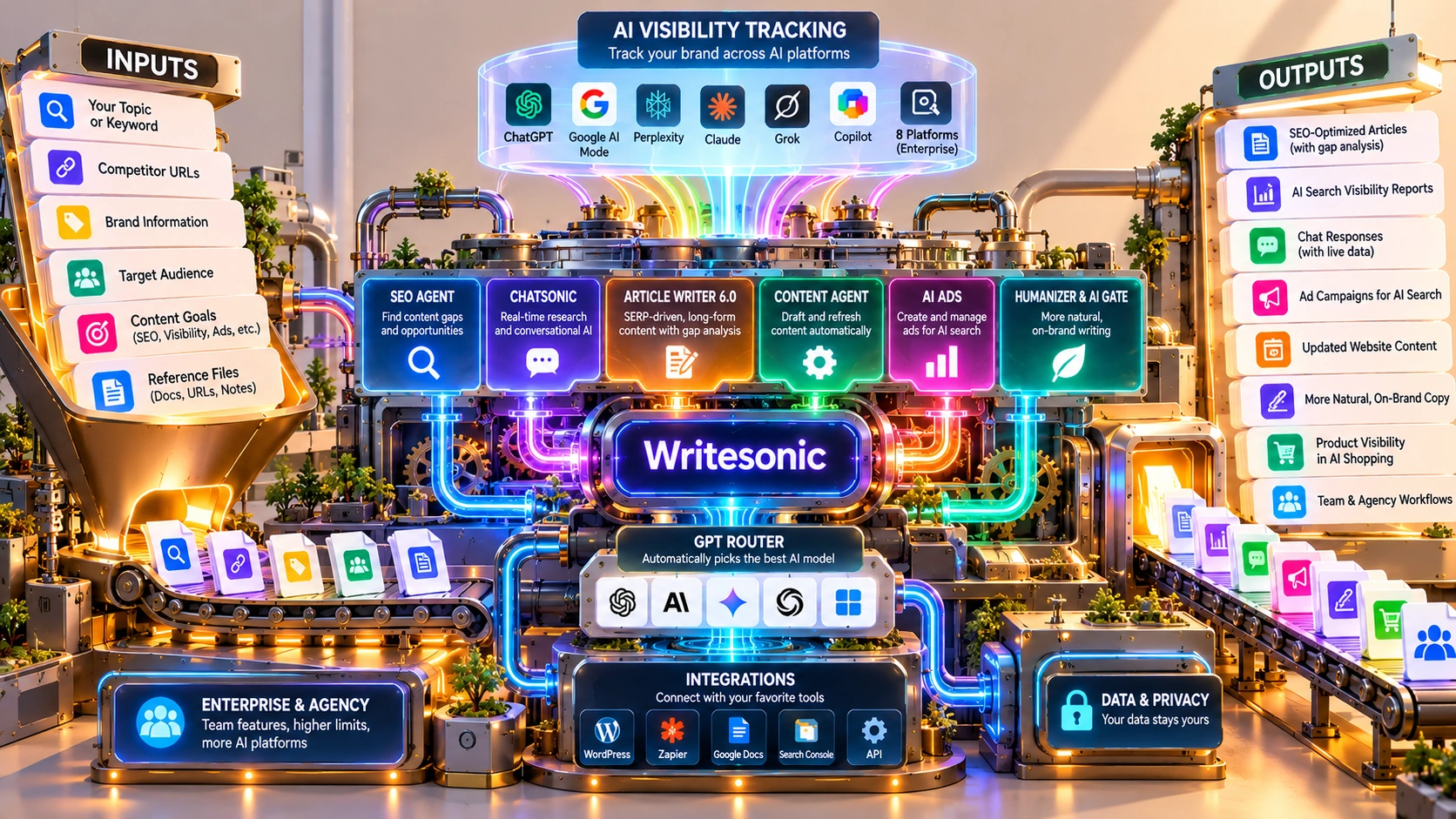
Writesonic now describes itself as an AI Search Growth Engine. It tracks how your brand appears in ChatGPT, Gemini, Claude, Perplexity, and Google AI Overviews. It then helps you act on the gaps it finds, using SERP research and content tools built on real-time data. It started in 2021 as an AI writing tool and pivoted in 2026 to lead with AI search visibility, with content generation now part of the stack underneath it.
Writesonic started in 2021 as an affordable AI writing tool, competing with Jasper and Copy.ai on speed and price. That's no longer the full picture.
In 2026, Writesonic repositioned around AI search visibility. The company's stated reason: a growing share of buyer research now happens inside ChatGPT, Gemini, and Google AI Overviews. Brands need to know whether AI platforms are recommending them or a competitor, and Writesonic built a product around answering that.
Content generation (Article Writer 6.0, Chatsonic) is still here. It now sits underneath the visibility tracking rather than being the headline feature. That shift matters for anyone reviewing Writesonic today: focusing only on Article Writer misses a large part of the current product.
When you open Writesonic for the first time, you don't start with a blank page or a prompt box. You start with a topic, a target keyword, and a search intent. The system scans what's currently ranking for that query before producing anything.
What you encounter in session one: Article Writer 6.0 is the flagship long-form engine, producing structured drafts with citations, headings, and internal linking suggestions. Chatsonic is a conversational AI with real-time web access, closer to a research assistant than a chatbot. A SERP analysis scans and summarizes competitor content before your draft begins, and inline SEO suggestions flag heading structure, keyword density, and content gaps as you write. The same workflow covers multiple output formats: blog posts, landing pages, ad copy, and social content.
The main idea is simple: Writesonic does the search research before it starts writing.
Most reviews position Writesonic as a fast AI writer with SEO features. That's accurate, but it misses the bigger distinction: the competitive analysis happens before the draft, not after. Many AI writing tools treat SEO analysis as a separate step; Writesonic puts that research earlier in the workflow. It scans the top-ranking pages for your target keyword, works out what they cover and what they miss, and shapes the draft around those gaps before you write a word. Draft structure, heading hierarchy, and content angles follow from that gap analysis rather than from what the model thinks should rank.
Writesonic can also pull in current search results and web data while researching, which matters for topics that change quickly, such as product updates, market developments, and recent research. A model without access to current web data cannot directly verify something that happened after its training data was collected. A tool with live search access can.
Before a draft is finished, Article Writer runs it through what Writesonic calls a "Humanizer & Gate" phase. Per Writesonic's own documentation, this strips common AI-sounding patterns (em dashes, filler phrases, predictable rhythm), adds EEAT signals (author attribution, reviewer information, publication dates), and checks citations against first-party sources, before the draft is considered done.
Worth being precise about what this is and isn't. That's different from the way some third-party sites describe AI humanizers as detector-bypass tools. Writesonic's own documentation frames this feature around content quality and search, tied to Google's Helpful Content guidance, not detector evasion; we found no claim on Writesonic's own pages about beating tools like Turnitin, GPTZero, or Originality.ai.
Writesonic's own positioning now leads with tracking and boosting AI search visibility, not writing. The company frames this as the AI Search Loop: Track, Prioritize, Act, Measure. It tracks brand and prompt visibility across AI platforms, prioritizes the gaps most worth closing, acts by generating content, citations, or outreach to close them, and measures whether the fix actually moved visibility. Roughly what Google Search Console does for traditional search, applied to AI-generated answers instead.
Brand & Prompt Tracking monitors how often a brand appears in AI-generated answers across ChatGPT, Gemini, Claude, Perplexity, and Google AI Overviews: which platforms mention it, sentiment, and which competitors show up in the same answers. Coverage depth varies by plan tier.
The AI Ads Tracker is a newer addition responding to a newer problem: AI platforms have started inserting sponsored placements into generated answers, so this tracks which brands are buying ad placement on a given prompt and tracks new advertisers entering a category, showing organic citations alongside paid ones.
Shopping & Agentic Commerce Tracking is built for e-commerce brands specifically. It tracks how products appear in AI-generated shopping recommendations, including which merchant link an AI platform sends a buyer to when it recommends a product, compared against competitors in the same category.
All three are live, named Writesonic products, confirmed directly on writesonic.com. We have not independently verified the specific visibility percentages or performance claims Writesonic publishes about them, so none are repeated here.
Four official videos, covering the thinking behind AI search visibility, a live look at checking brand presence on ChatGPT, and a walkthrough of the GEO dashboard itself.
Part 1 of a two-part conversation with Christian Goodrich and Sam Garg on why AI search visibility is starting to move revenue, and what the brands ahead on it are doing differently.
Part 2 of the same conversation with Christian Goodrich and Sam Garg, continuing the discussion of what winning brands do differently on AI search visibility.
A direct look at checking whether, and how, a brand gets mentioned when someone asks ChatGPT about it.
A walkthrough of the GEO dashboard itself: where to find brand tracking, prompt monitoring, and the other pieces covered above.
A visibility score from a tool like this is useful, but it's easy to over-read. A few limits worth keeping in mind before treating it like a search-rankings dashboard: visibility isn't traffic. Being mentioned inside an AI-generated answer doesn't mean the person reading that answer clicks through to your site, the way a search-results click does. AI answers also aren't stable in the way a Google ranking is: the same prompt can return a different answer depending on the session, the model version, the user's location, or simply the date it was asked. A tool tracking this is sampling a moving target, not reading a fixed scoreboard. That doesn't make the tracking useless, it's still the closest thing available to a direct answer, but it's a different kind of number than a search rank, and worth treating that way.
| Tool | Primary Focus | AI Visibility / GEO Tracking |
|---|---|---|
| Writesonic | AI Search Growth Engine, visibility tracking as the core product, SERP-aware content generation underneath it. | Yes, the AI Search Loop (Track, Prioritize, Act, Measure) is the product's current centerpiece. |
| Jasper | Brand consistency and governed content generation for marketing teams. | Yes, Jasper launched its own GEO Agent and GEO Hub in June 2026, tracking citation rate, brand presence, and sentiment across ChatGPT, Gemini, and Claude. Enterprise-focused. |
| Copy.ai | Workflow automation for high-volume marketing copy. | Not confirmed. We found no evidence Copy.ai currently offers dedicated AI visibility or GEO tracking. Confirm directly if this matters to your decision. |
| ChatGPT | General-purpose conversational AI. | No. ChatGPT is one of the platforms being tracked by tools like Writesonic and Jasper, not a tool for tracking your own brand's visibility. |
A few things it does particularly well, worth calling out specifically:
SERP-driven drafts mean the AI scans live Google results for your target keyword before writing a single sentence, so structure, headings, and content angles follow what's currently ranking.
The gap analysis sits at the point of creation rather than as a post-hoc audit. Those gaps shape the outline and the topics covered before the draft starts, not after.
Chatsonic adds a real-time web research layer inside a conversational interface, useful for checking a statistic or exploring an angle without leaving the platform.
Article Writer 6.0 produces one-click long-form drafts with citations, heading structure, and internal linking suggestions already built in.
The stack is consolidated. One system can replace a separate SEO research tool, AI writer, and content chatbot, which can save time for someone running the whole process alone.
And the AI visibility tracking is the newest piece. Seeing where a brand stands inside ChatGPT and Gemini answers isn't something a standalone AI writer or a traditional SEO tool offers.
Three named agents handle different parts of the workflow. The SEO Agent connects to data sources like Ahrefs and Google Search Console to automate keyword research and competitor analysis. The Content Agent handles drafting and refreshing pages based on the gaps identified by the SEO and visibility tracking layers. Here, the gap analysis does a second job: it feeds an agent instead of just informing a human writer. The Outreach Agent identifies sites citing competitors instead of you and drafts the outreach to try to change that.
Writesonic reports on agent activity, what got researched, drafted, or refreshed, and what changed in visibility afterward, as part of the Track/Prioritize/Act/Measure loop. We have not independently verified the specific efficiency or ROI percentages Writesonic publishes about these agents, so none are repeated here; ask for current benchmark data directly if that's a deciding factor for you.
GPT Router is Writesonic's own open-source model-routing layer, confirmed on GitHub and documented separately from the main product. It sits between Writesonic and the underlying LLMs (OpenAI, Anthropic, and others), switching models automatically if one is slow or down, so a single provider outage doesn't take down content generation. It also gives Writesonic access to multiple models, GPT-4o, Claude, and others, without users needing to configure that themselves. For most users this runs invisibly in the background; it's mainly worth knowing about as the reason Writesonic's generation tends to stay available even when a single underlying AI provider has issues.
The exact mechanics of running one piece of content through the system, step by step:
Writesonic runs four tiers, all month-to-month with an annual-billing discount, per Writesonic's official pricing page, checked October 2026.
$948/yr billed annually, saves $240.
$2,388/yr billed annually, saves $600.
Most popular. $4,788/yr billed annually, saves $1,200.
Contact sales.
A few things worth knowing before picking a tier. AI platform coverage scales by tier: Starter, Basic, and Growth track ChatGPT, Gemini, and Google AI Overviews, while Enterprise adds Perplexity, Claude, Grok, Microsoft Copilot, and Google AI Mode, bringing the total to eight tracked platforms. The Action Center (automated on-page/off-page optimization) is unavailable on Starter and Basic; Growth gets limited trial access (5 off-page + 5 on-page actions/month), and full access is Enterprise-only. Sentiment analysis is Growth-and-up only. Compliance certifications (SOC 2 Type II, HIPAA, GDPR) and SSO/SAML are Enterprise-exclusive, per Writesonic's own pricing page, so confirm current certification documentation directly with Writesonic before relying on it for a regulated deployment. Additional seats cost $50/user/month on Basic or Growth. All plans include free trial signup, no credit card required.
The practical question behind any of these prices is how far the included limits actually stretch. On Starter, 15 articles a month works out to roughly one every two days, fine for a true solo operator publishing a couple of times a week, tight for anyone running a more active content calendar. Basic's 25 and Growth's 50 give more room, but the jump from $79 to $399 is also a jump in daily prompt/answer monitoring (50 to 200) and answers tracked (50 to 600), not just article count, so the right tier depends on which limit you'd actually hit first: content volume, or visibility-tracking depth.
G2 reviewers' top complaint about cost specifically calls out "confusing pricing and word/credit limits that push users toward buying extra credits." G2 reviewers report that exceeding included limits can lead to additional credit costs, so it's worth checking the current overage terms before assuming the listed plan price is your total monthly cost.
Writesonic maintains SOC 2 Type II certification and states GDPR and HIPAA compliance, with SSO/SAML available on Enterprise plans. As with any vendor compliance claim, confirm current certification documentation directly with Writesonic before relying on it for a regulated deployment.
Enterprise plans also support tracking multiple brands or clients from one workspace, with white-label reporting for agencies managing AI visibility on behalf of clients, and access to a dedicated AI search strategist for planning execution. Writesonic is built for teams of all sizes, though the features that matter most to agencies and enterprises sit at the top of the plan structure, not the entry tier.
On the analytics and search side, Writesonic connects to Google Analytics, Google Search Console, and Looker Studio, so AI visibility and SEO data can sit alongside existing traffic reporting instead of in a separate dashboard. For content and workflow, it also confirms WordPress publishing, Zapier for workflow automation, and MCP (Model Context Protocol) support for connecting Writesonic to other AI tools and agents. On YouTube specifically, it pulls search results, video metadata, and full transcripts as research input, then can publish new videos or update existing ones when it identifies a content gap worth filling.
API access exists for workflow integration, documented separately at docs.writesonic.com, with a Chatsonic-specific API alongside the general one. Writesonic's own public documentation doesn't publish detailed endpoint-level capabilities outside a gated API Reference section, so beyond confirming it exists and is aimed at teams building their own content or SEO automation around Writesonic, we can't give a more detailed breakdown of what it can and can't do without access to that gated reference. If API depth matters to your decision, ask to see the reference docs directly before committing to a plan.
Writesonic's own privacy policy states it does not use customer data to train or fine-tune any general-purpose, foundation, or large language model, for paid accounts, free trials, or free-tier users alike. It says it may use de-identified, aggregated data that can't identify an individual customer to improve service quality and safety.
That said, your inputs can pass through third-party model providers when content is generated. The policy names OpenAI, Anthropic, and Microsoft Azure, each of which has its own data policy. OpenAI states it can retain data for up to 30 days for safety monitoring; Anthropic states it doesn't train models on customer content. Worth knowing if your content includes anything sensitive.
On retention, Writesonic's policy lists specific windows: active account data persists for the life of the account, deleted-account data for up to 30 days before permanent deletion, billing and tax records for 7 years, support tickets for 3 years, and server access logs for 90 days. The policy doesn't spell out a specific retention window for data pulled in through connected integrations like Google Search Console or Analytics beyond saying it's used only to provide the integration you've enabled.
Writesonic holds a 4.7/5 rating on G2 based on 2,144 verified user reviews, per G2's product page, checked October 2026. The theme breakdown and mention counts below are from the review analysis used on the previous version of this page, not independently re-mined from G2 this round; the overall rating and review count are freshly checked.
What Users Love
Top Concerns
G2 ratings and review counts change over time. Check G2's current Writesonic page for the latest figures before relying on this summary.
| Platform | Browser-based, cloud. No installation required. Processing and SERP analysis happen in the cloud in real time. |
| Core Engine | A hybrid of LLM generation and real-time search. The LLM generates the text; the search layer supplies current information and context for it to work from. |
| AI Visibility Tracking | Cross-platform GEO tracking. Monitors brand mentions, citations, and sentiment across ChatGPT, Gemini, Claude, Perplexity, and Google AI Overviews. Depth of coverage varies by plan tier. |
| SEO Engine | SERP-aware competitor analysis. Scans live Google results for target keywords and identifies content gaps across top-ranking pages before draft generation begins. |
| AI Chat | Chatsonic, real-time and conversational. Live web access inside a chat interface, functioning as a research assistant to verify claims or explore angles without leaving the platform. |
| Article Writer | Version 6.0, the flagship content feature. One-click long-form generation with citations, heading structure, internal linking suggestions, and keyword integration. Best used as a structural first draft. |
| Model Infrastructure | GPT Router, Writesonic's own open-source LLM routing layer. Switches between underlying models (GPT-4o, Claude, others) for uptime and access, mostly invisible to the end user. |
| Data Source | Live web data for current relevance: real-time statistics, recent developments, and current competitor positioning, which matters most for time-sensitive content. |
| Output Types | Text: blog, ads, landing pages. No native image or video generation, but broad text output coverage across marketing content types. |
| API Access | Exists for workflow integration, documented separately (see Integrations above for what we could and couldn't confirm about it). |
| Automation Level | Moderate, with an agent layer. The SEO Agent and related agents automate research and drafting tasks that would otherwise be manual. |
| Brand System | Limited, with no persistent brand memory comparable to Jasper's brand kit. Tone and voice guidance must be provided manually per generation. |
| Compliance | SOC 2 Type II, GDPR, HIPAA stated, Enterprise tier only (see Pricing). Confirm current certification status directly with Writesonic for compliance-critical use. |
Multiple tools, input flows, and output options compete for attention; most people spend it exploring rather than producing. The better entry point is running one real piece through Article Writer 6.0 end to end, keyword to draft, before touching anything else.
Article Writer and Chatsonic settle into the primary workflow, and the SERP analysis starts to feel like a normal first step rather than an extra one. This is also the point where the gap analysis shifts from a feature you're trying out to a step you're actually using to make editorial calls, what to cover, in what order, before the draft starts.
The real payoff isn't that any single feature is best-in-class; it's that the workflow is faster than assembling the same capability from three separate subscriptions.
The clearest fit is the solo marketer handling content, SEO, and distribution without the time to manage several separate tools.
Whose success metric is page one rather than readership, benefits from a tool that builds the competitive-gap research into the generation process itself, rather than treating SEO as a separate audit step.
Gets research, writing, and SEO functionality in one subscription instead of paying for several separate tools (see Pricing above).
A different tool may be a better fit in these cases:



Writesonic trades specialization for consolidation. Here's when that trade-off works against you:
As of 2026, Writesonic has repositioned itself as an AI Search Growth Engine, a GEO platform tracking how your brand appears across ChatGPT, Gemini, Claude, Perplexity, and Google AI Overviews. Content generation (Article Writer 6.0, Chatsonic) is still part of the product, now sitting underneath the visibility tracking rather than being the headline feature.
GEO is optimizing content and brand presence so AI platforms cite or recommend you in generated answers, the way SEO optimizes for traditional search rankings. Writesonic's AI Search Loop, Track, Prioritize, Act, Measure, is built around this.
ChatGPT generates content from training data that may be months or years old. Writesonic can pull in current search results before writing, and separately tracks how your brand is actually being mentioned inside ChatGPT and other AI platforms, something ChatGPT has no way to report on for you.
Writesonic maintains SOC 2 Type II certification and states GDPR and HIPAA compliance, with SSO/SAML on Enterprise plans. Confirm current certification documentation directly with Writesonic before relying on it for a regulated deployment.
Writesonic's own open-source model-routing layer, which switches between underlying LLMs (GPT-4o, Claude, others) to keep generation available if one provider is slow or down. It runs invisibly in the background for most users.
Yes, Enterprise plans support multi-brand tracking and white-label reporting for agencies managing AI visibility on behalf of clients. The entry-level Starter tier is scoped for a single solo operator.
Four tiers: Starter at $79/month, Basic at $199/month, Growth at $399/month (most popular), and custom-priced Enterprise. Annual billing saves 2 months on every self-serve tier. Per Writesonic's official pricing page, checked October 2026.
Jasper centers on brand consistency: a governed content-generation workspace built for marketing teams, with a dedicated GEO Agent and GEO Hub (launched June 2026) aimed at enterprise visibility tracking. Writesonic centers on SERP-aware content creation with AI visibility tracking built in from the Starter tier up, aimed more at solo operators and small teams than enterprise governance. If persistent brand memory across a team matters most to you, Jasper fits that better; if SEO/GEO research baked into the writing process at a lower entry price matters more, Writesonic fits that better.
No. Writesonic's privacy policy states it doesn't use customer data to train or fine-tune any general-purpose, foundation, or large language model. Inputs do pass through third-party model providers (OpenAI, Anthropic, Microsoft Azure) during generation, and each has its own separate data policy.
What started as an affordable AI writing tool in 2021 has become something structurally different. The writing and SERP-research layer, Article Writer 6.0, Chatsonic, the gap analysis running underneath both, is still genuinely strong, and it's still the reason most people first try Writesonic. But the 2026 pivot changed what the product is: an AI Search Growth Engine built around tracking and improving brand visibility inside ChatGPT, Gemini, Claude, Perplexity, and Google AI Overviews, with content generation now running underneath that tracking instead of defining it.
It isn't trying to be the best specialist writer, the tightest brand-voice tool, or the deepest traditional SEO suite. The bet it's making is simpler: that the next few years of marketing will be decided as much by what AI platforms say about a brand as by where it ranks on a search results page, and it's building the loop (track, prioritize, act, measure) around that idea.
The practical version: it helps you find out whether AI systems mention your brand, see where competitors are ahead, and act on those specific gaps, rather than just helping you write faster.
The free trial includes Article Writer 6.0 and Chatsonic. Run one article through the full SERP-to-draft workflow before evaluating the AI visibility tracking tiers.
Independent review. Prices and features may change; always check the official Writesonic site for the latest information.
 Grammarly
 Writesonic
 Wordtune
 Hemingway Editor