 UseArticle
 Emergent
 Runable
 Carrd
Carrd
Emergent: AI App Builder for Full-Stack Applications
The Agentic Engine for Full-Stack Apps.
What is Emergent?
Emergent is a cloud-native software factory, built for real applications rather than quick prototypes or simple sites. Its proprietary multi-agent architecture — Planning, Frontend, Backend, and Quality agents working in coordination — builds entire full-stack applications from a single conversation. It provisions databases, manages Kubernetes infrastructure on Google Cloud, validates API connections before building, and self-corrects logic errors in real time.
We put Emergent to the test:
a premium SaaS landing page, built from one brief
We handed Emergent AI a long, deliberately demanding prompt to see how it holds up against a hard brief, not just a marketing claim: build a complete, production-quality landing page for a fictional content-and-visibility platform we called "Varity," with a full design system, a characterful type stack, two complementary accent colours, an interactive product-dashboard mockup, a memorable signature visual motif, thirteen sections in a set order, and strict rules against inventing customers, statistics, or brand logos. We then scored the result across ten parameters. Every screenshot below is the tool's own output, and all data in it is placeholder, exactly as the brief required.
The exact brief we gave Emergent
Nothing summarised — this is the full, verbatim prompt Emergent AI was scored against, so the test is reproducible.
Role. Act as a senior product designer and frontend engineer at a studio known for premium, original enterprise SaaS design. Build a complete, production-quality landing page — not a template.
Product — Varity. A content and visibility optimization platform. It doesn't just watch how a brand shows up across AI search — it audits your actual content and competitors and tells you exactly what to fix. AI visibility is one major pillar, not the whole product. Traditional SEO tools were built for Google rankings; AI-search tools only watch what LLMs say. Varity does both, plus the content-level work between: page- and site-level audits (Ranking Audit, Head-to-Head, Brand Deep Dive), pre- and post-ship accuracy checks (Asset Audit, Post Publish Audit), competitor tracking (Competitor Radar), traditional keyword position (Rank Tracker), and AI-assistant visibility (Geo Scan). Every output produces concrete, prioritized actionables — what to rewrite, which gap to close, which page is losing ground and why — turning "here's data" into "here's what to do next," across both classic and AI search, continuously.
Core message. Companies optimized for Google yesterday; tomorrow they'll need to optimize for how AI describes and recommends them too — and winning either one starts with the same question: is your content actually good enough, and where exactly does it fall short of what's winning right now? This idea should thread through the hero, "The Shift" section, and the final CTA — reinforced, not restated identically.
Target audience. Marketing teams, SEO professionals, agencies, founders, growth teams, SaaS companies, ecommerce brands, and content teams — anyone who needs their content to win, whether the judge is a Google ranking algorithm, a human comparing two pages, or an AI model deciding who to recommend.
Core features (design the page around these):
- Ranking Audit — audit a single page against the top-ranking pages for a keyword: what they cover that you don't, what's holding you back, and the one fix that moves the needle most.
- Head-to-Head — your page directly against one competitor's page: positioning, content gaps, structural differences, and concrete fixes.
- Brand Deep Dive — a full-site pass scored on accuracy, UX, and trust signals, surfacing weakest pages and what to fix on each.
- Asset Audit — check any content or creative against a source of truth before it ships, for accuracy, terminology, completeness, and tone.
- Post Publish Audit — re-check live pages against what should be true, catching drift, outdated claims, and inconsistencies.
- Competitor Radar — continuously monitor competitor pages for changes (pricing, messaging, features) as they happen.
- Geo Scan (AI Visibility) — whether ChatGPT, Claude, Gemini, Perplexity, and Copilot mention you, what they say, who they recommend instead, and how it differs by region.
- Rank Tracker + Automated Monitoring — track traditional keyword positions over time and schedule any audit to run automatically.
Design direction. Premium enterprise SaaS quality — the craftsmanship, typography, spacing, and polish of Linear, Stripe, Vercel, Notion, Perplexity, Framer, and Arc, without copying any layout. Define a compact design system first: a 4–6 colour palette with a confident base and two complementary accents (one for AI/model context, one for content/audit signal states); a characterful display face, a clean body face, and a monospace/utility face for data and labels; and one memorable signature motif that embodies "auditing content and scanning AI visibility" (e.g. a radar/scan-line that doubles as a before/after content comparison), used deliberately. Avoid generic AI-design defaults: no cream-plus-serif-plus-terracotta, no near-black-plus-single-acid-accent, no newspaper grid.
Page structure (build all, in order): 1) Navigation; 2) Hero with the signature scanning/audit motif; 3) Trusted-by (placeholder logos, clearly marked); 4) The Shift — traditional vs. AI search as two fronts of the same content-quality problem; 5) Product Overview; 6) Interactive Product Dashboard Mockup (tabbed views for every feature); 7) Core Features grid; 8) How Varity Works — Audit → Compare → Improve; 9) Why This Matters (qualitative, no invented statistics); 10) Pricing Preview (clearly labeled placeholders); 11) FAQ accordion; 12) Final CTA; 13) Premium multi-column footer (placeholder links, clearly marked).
Dashboard mockup. A realistic, interactive mockup with clearly-labeled sample data, including views for Ranking Audit results, Head-to-Head comparison, Brand Deep Dive per-page scores, Asset / Post-Publish findings, Competitor Radar activity feed, Geo Scan / AI Visibility results by region, visibility and ranking trends, and scheduled reports and credit usage — establishing the component language (cards, tables, charts, badges, tabs) the real product would extend.
Hard constraints. Do not invent customers, testimonials, statistics, awards, funding, integrations, or performance claims. Use clearly-labeled placeholders wherever real information is missing. Named AI assistants may be referenced by name as the subject of monitoring — no logos or trademarks.
Technical requirements. Fully responsive (mobile, tablet, desktop); reusable components (buttons, cards, badges, tabs, accordion) built as a system; accessible (visible focus states, semantic HTML, sufficient contrast, reduced-motion support); motion used deliberately rather than scattered hover effects.
Deliverable. A single, complete, polished landing page with world-class information hierarchy and a premium SaaS design system that can extend into the logged-in Varity application.
First, it asked the right questions
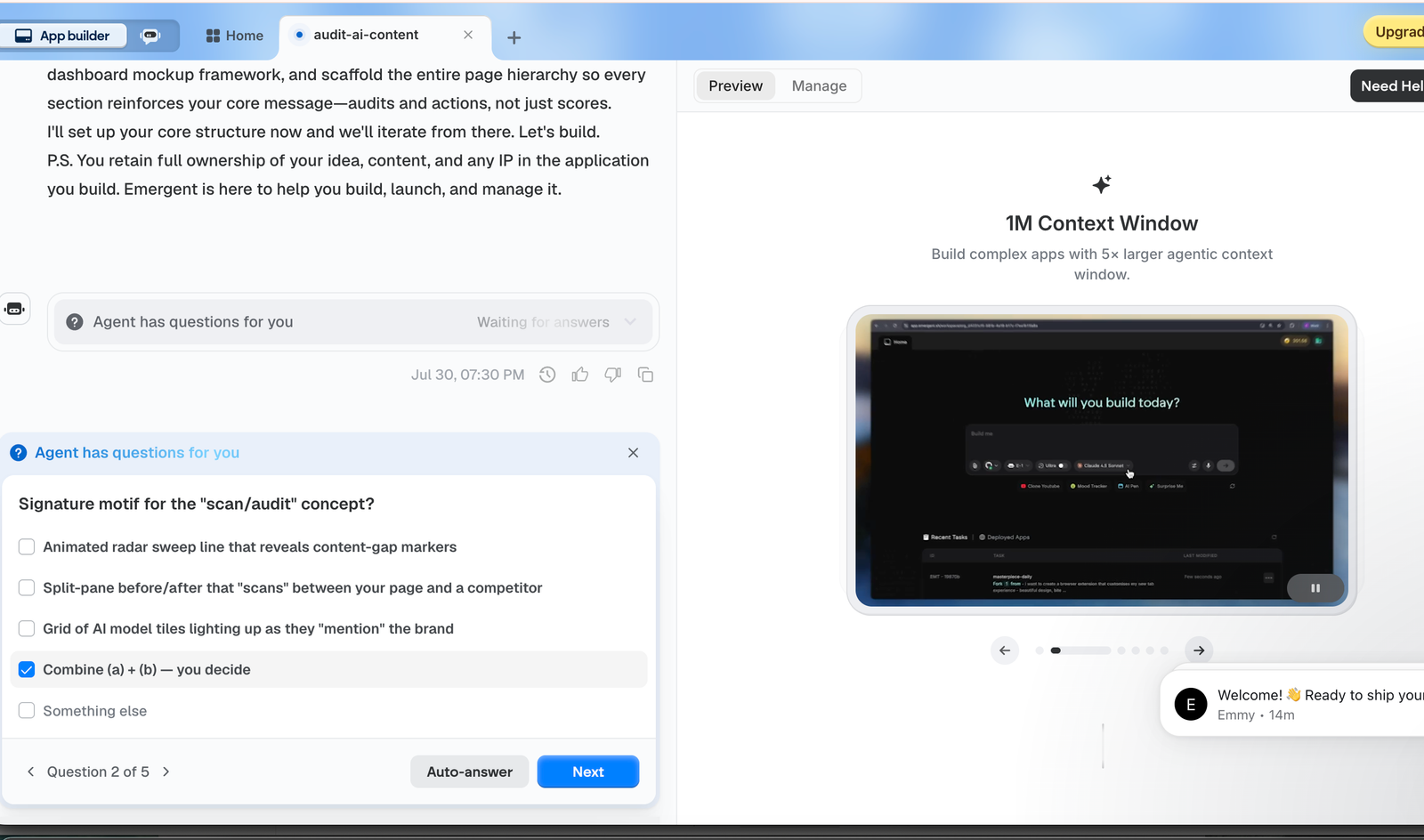
Emergent AI did not dive straight into code. It opened with a five-question intake — visual mood, the signature "scan/audit" motif, static versus wired-up integrations, brand tone, and the logo — then built against those answers. That product-manager-style kickoff is exactly the behaviour the rest of this review describes.
What it built
The output was genuinely premium — Linear- and Stripe-tier craft, an original editorial-tech look rather than a generic AI-design default, and the exact scan-line-and-radar motif we asked for. A tour of the key screens:
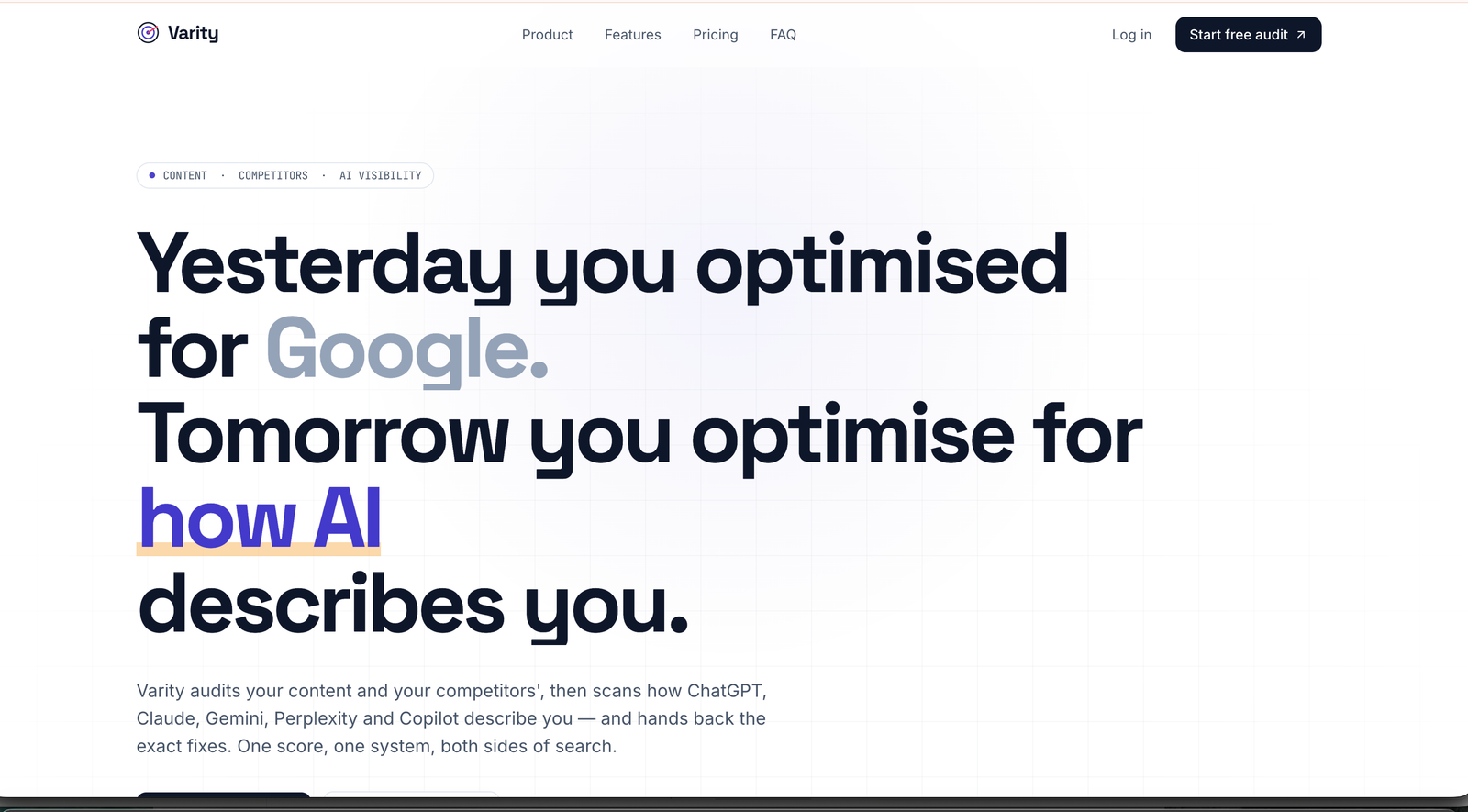
"Yesterday you optimised for Google. Tomorrow you optimise for how AI describes you." The brief's central idea, stated cleanly, with the five AI assistants named in the subhead.
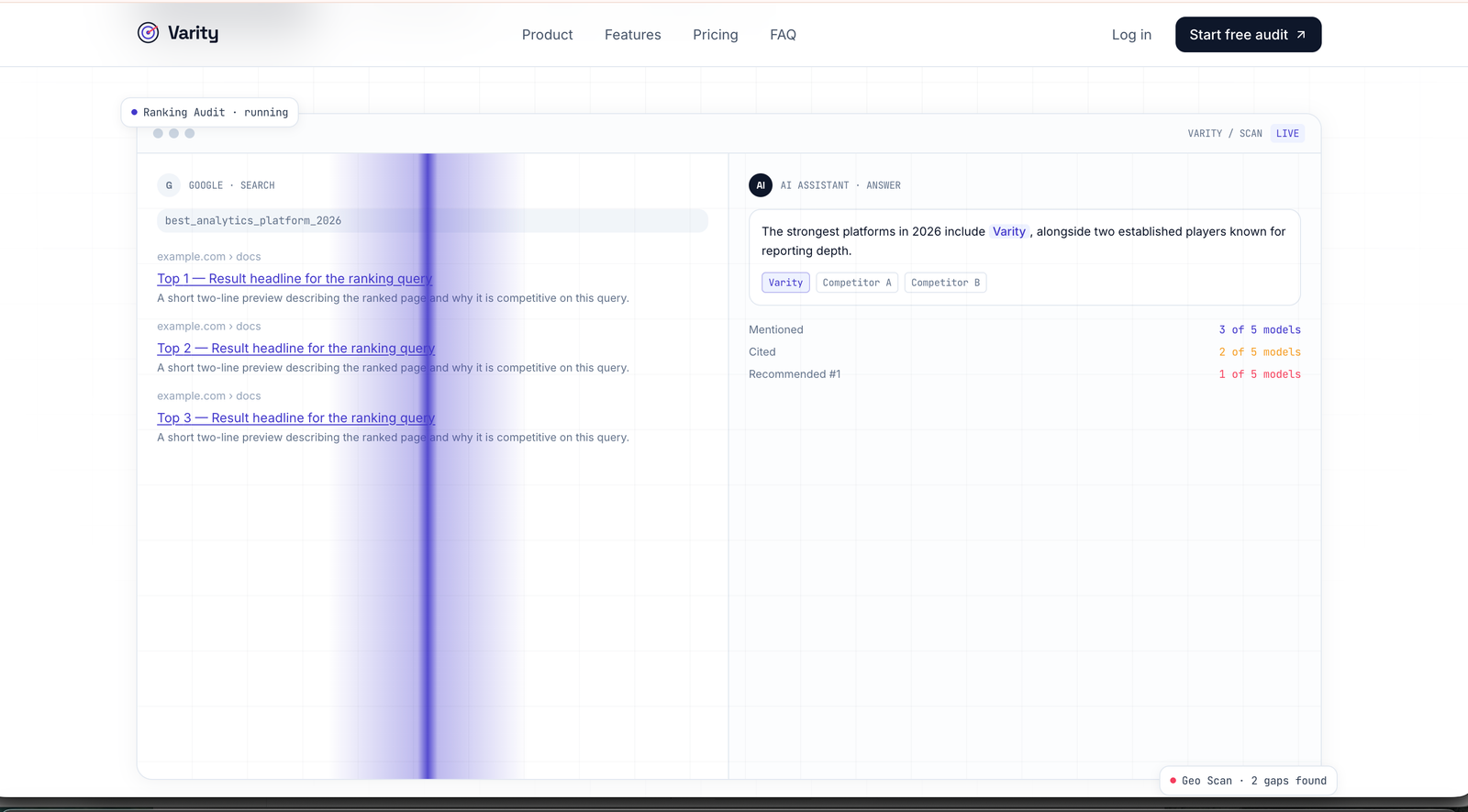
A vertical scan line splits a Google result (left) from an AI answer (right) — the "combine radar + before/after split-pane" motif we selected, delivered and used with restraint.
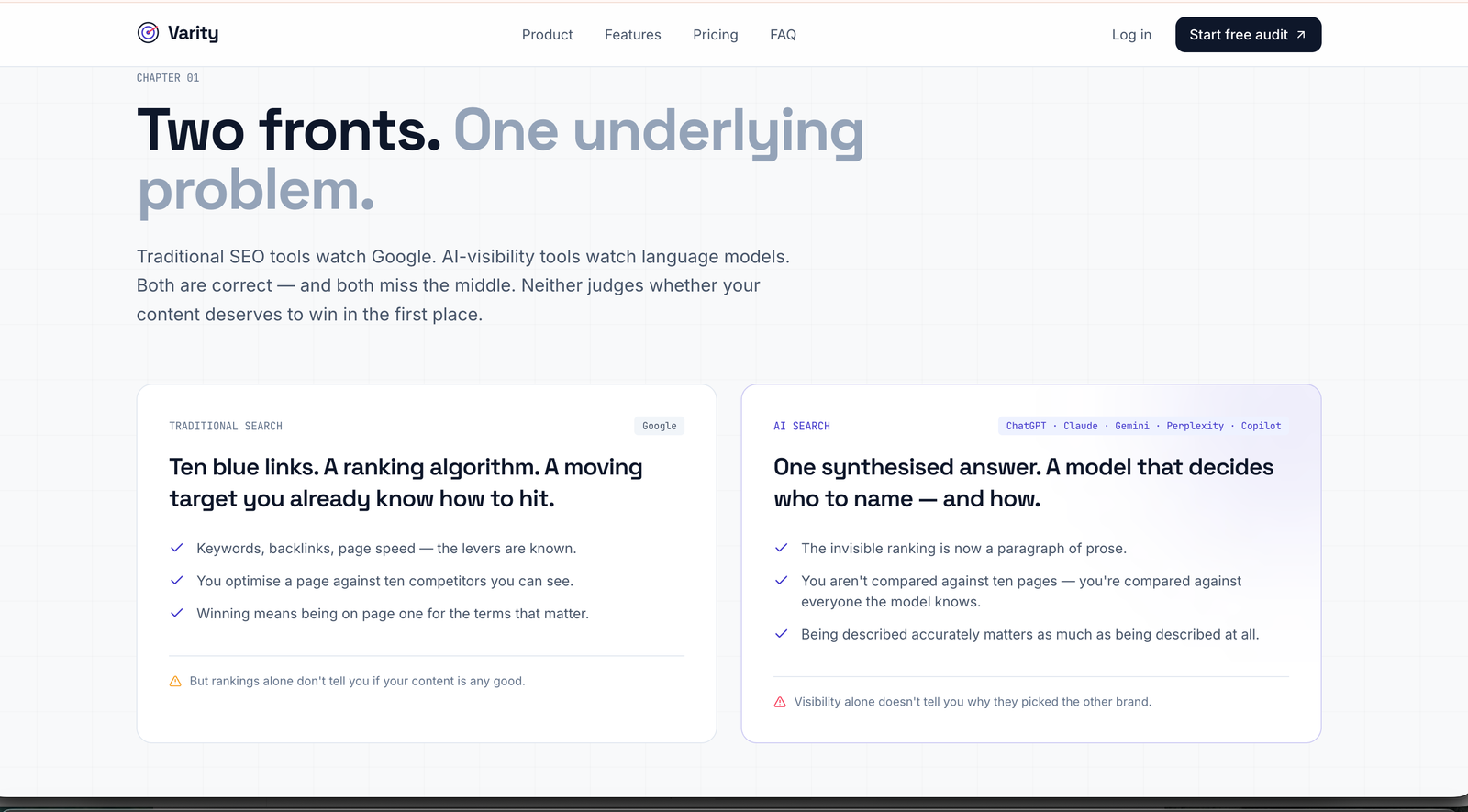
"Two fronts. One underlying problem." Traditional search vs. AI search, framed as two sides of the same content-quality question — exactly the framing the brief asked for.
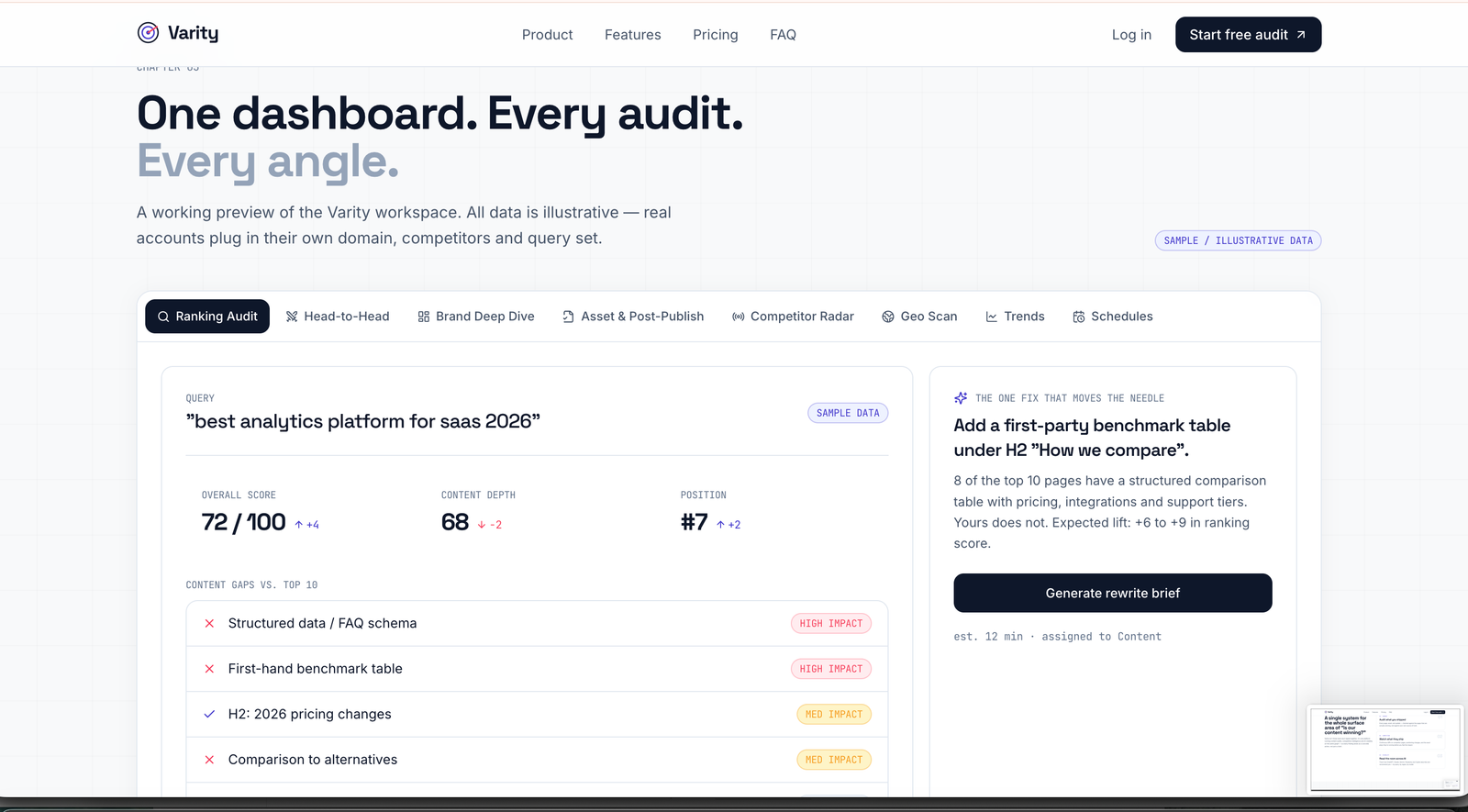
A tabbed workspace covering all eight product views, with a real component language — cards, tables, impact badges, score deltas — and a clear "SAMPLE / ILLUSTRATIVE DATA" label.
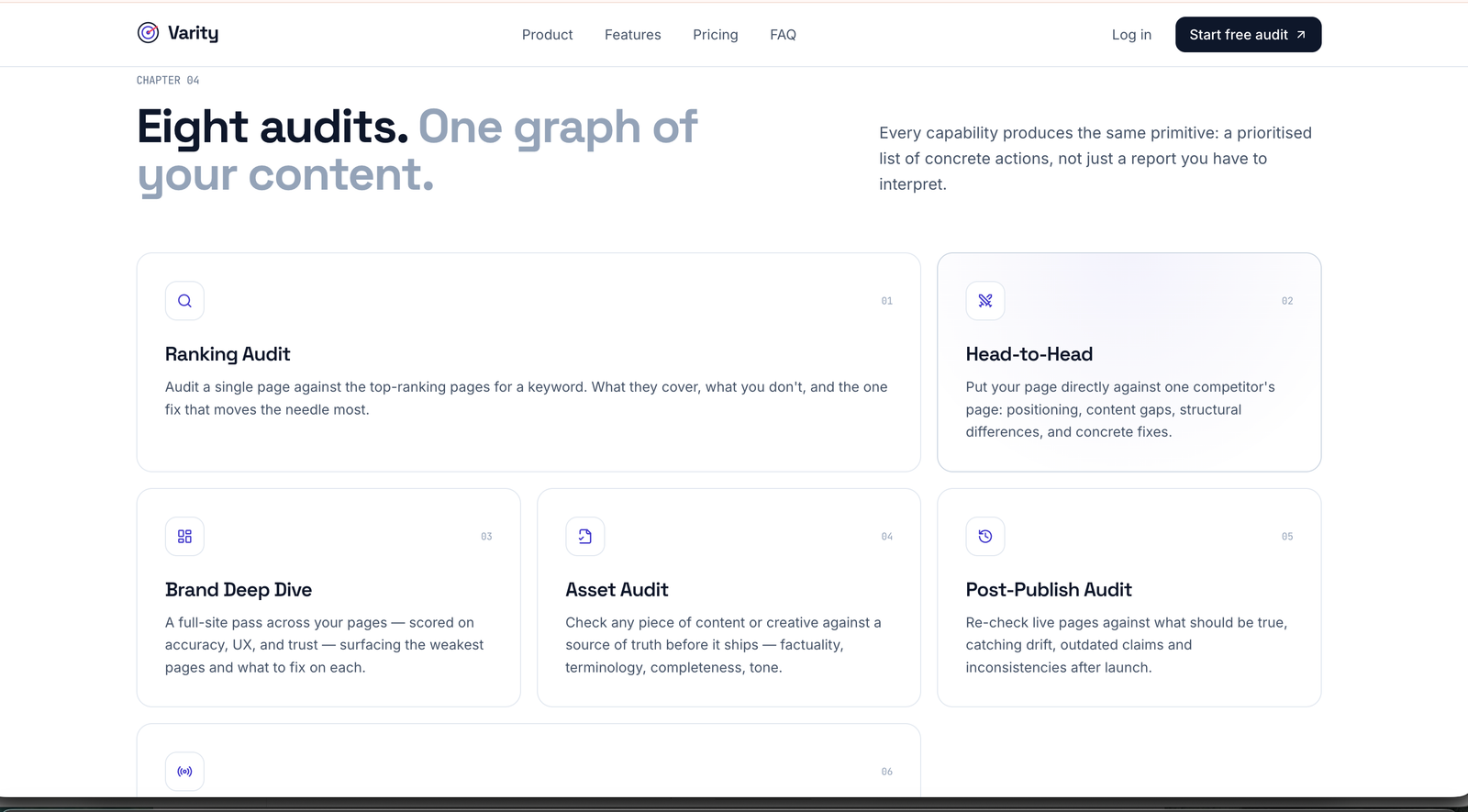
All eight features are present and well written, but the layout runs two wide cards on the first row and three narrower ones below, so the card widths do not line up. The single craft slip on an otherwise clean page.
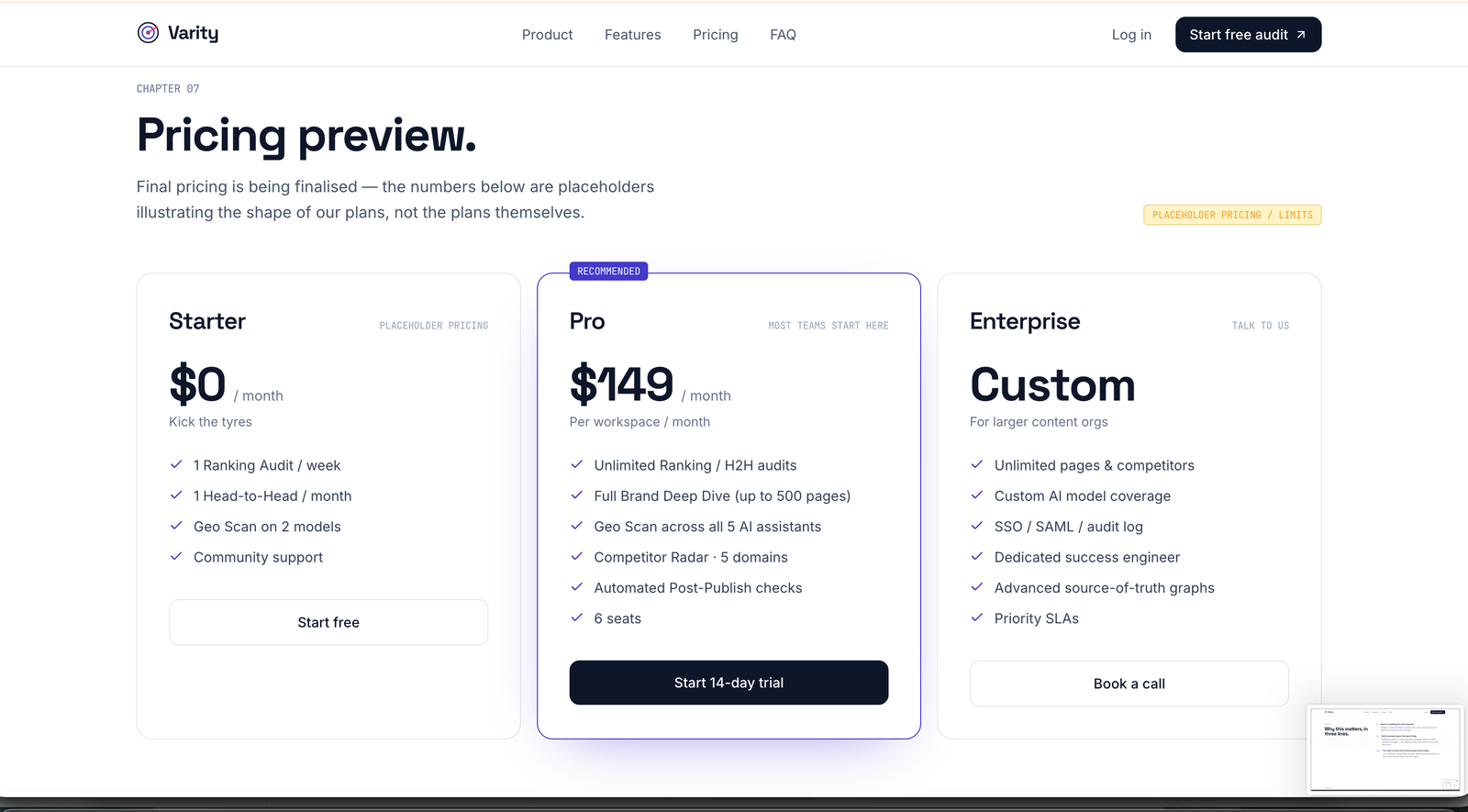
Starter / Pro / Enterprise tiers, clearly badged "PLACEHOLDER PRICING / LIMITS" with a note that final numbers are not set. No invented pricing presented as real.
The scorecard
We scored the build across ten parameters. Responsiveness and accessibility were required by the brief and hold up on the live build, but are not fully judgeable from static screenshots, so they sit outside the scored average.
| Parameter | Score & why |
|---|---|
| Prompt adherence — structure | 9.0/10 — 12 of 13 required sections built and in order; only the placeholder "trusted-by" logo strip was omitted. |
| Core message & copywriting | 9.5/10 — the central idea is threaded through the hero, "The Shift," and the final CTA, worded differently each time. Sharp, no filler. |
| Design system & component consistency | 8.5/10 — a real reusable system (cards, badges, tabs, tables), let down by the uneven feature-grid card widths. |
| Visual hierarchy & layout | 9.0/10 — confident spacing, a clear editorial "Chapter 01–09" spine, and a strong two-tone headline treatment. |
| Typography & type system | 9.5/10 — three faces used with discipline: a characterful display, a clean body, and monospace for all data, labels, and scores. |
| Colour & signal-state system | 9.5/10 — one accent for the AI/model context, plus green/amber/red for pass, gap, and fail states — exactly as briefed. |
| Signature motif | 9.5/10 — the scan-line and radar sweep delivered as chosen and used deliberately (hero + CTA), not sprayed everywhere. |
| Dashboard mockup fidelity | 8.5/10 — all eight tabs present and sample-labeled, but only the Ranking Audit view is shown fully populated. |
| Originality | 9.5/10 — avoided the generic AI-design defaults (no cream-serif-terracotta, no acid-accent-on-near-black); the result feels bespoke. |
| Constraint compliance & placeholder honesty | 10/10 — no invented customers, statistics, or logos; every placeholder clearly labeled; AI assistants named as text, not logos. |
| Overall | 9.2/10 — the average across the ten parameters above. |
Emergent AI followed a long, dense design brief almost completely, and produced original, premium enterprise-SaaS work — a genuinely reusable component system, the exact signature motif requested, and disciplined, honest placeholder handling throughout. The only real dings are one omitted placeholder logo strip and an uneven feature-grid that breaks the otherwise-immaculate alignment. For a single-prompt build against a brief this detailed, 9.2/10 is earned — and it is a strong demonstration of what the multi-agent system does when the specification is clear.
The Engineering Team in a Prompt —
architecture before interface
Most AI builders take a UI-first approach — they generate a beautiful frontend and leave you to figure out the database, the authentication, the API integrations, and the deployment infrastructure. Emergent starts with system architecture instead. The distinction matters enormously when what you are building has real complexity.
Emergent AI sits in its own category: AI-code, not low-code or no-code — a system that writes, tests, validates, and deploys production-grade software through conversation, using the same underlying frameworks a development team would use. React and Next.js for the frontend. Node.js or FastAPI for the backend. PostgreSQL or MongoDB for the database. Kubernetes on Google Cloud for infrastructure. These are the real technologies, generated and managed by a coordinated agent system, not simplified stand-ins.
The stack position: Dorik builds the launch layer — clean sites, landing pages, SEO directories. Durable builds the automation layer — service business operations. Emergent AI builds the application layer — the tools inside the directory, the SaaS product behind the landing page, the internal system that makes the business run.
One note on category, since this page sits alongside other website builders: if what you want is a website, this isn't it — Dorik, Durable, and Mixo elsewhere in this category cover that ground well. If what you want is the complete stack behind a real product — backend, database, authentication, deployment, not just a homepage — the platform is that stack.
Dorik builds your directory. Emergent AI builds the tools inside it.
From prompting
to product managing.
Your first session with Emergent AI feels different from every other AI builder — because it asks questions back. Instead of generating a generic template from your first message, it initiates what feels like a project kickoff.
- Connect GitHub immediately — before any code is written, this is non-negotiable
- Describe your application — the system asks architectural clarifying questions back
- Multi-agent system generates frontend, backend, database, auth, and deployment in coordination
- E3 Agent plans, builds, tests, and debugs with minimal hands-on direction — validating API connections before dependent logic is built
- Deployed SOC 2-compliant environment in under 20 minutes for straightforward applications
The realization that arrives quickly: you have shifted from prompter to product manager. The AI actively surfaces the architectural decisions that determine whether the application will actually scale, and asks you to make them before it starts building.
Emergent asks the questions that determine whether the architecture will hold, before you've written a single line yourself.
Emergent in Action:
official walkthroughs and independent demos
A mix of the platform's own launch and tutorial content alongside independent creator demos — useful for seeing the multi-agent workflow in practice before you commit a session to it.
Emergent's official launch video, introducing building production-ready apps through natural language conversation. (Emergent, official channel)
First episode of Emergent's official tutorial series, focused on structuring prompts and breaking down application architecture to get better results from the agent system. (Emergent, official channel)
An independent overview demonstrating full-stack application builds from a prompt. (Software Scope, independent creator)
Independent walkthrough of the E3 Agent, described as a more autonomous, Pro-plan builder that plans, builds, tests, and debugs with less hands-on direction than earlier agents. (Background Artisan, independent creator) — this covers a capability not otherwise mentioned in this review.
Self-healing full-stack logic —
the real differentiator
Generation speed draws most of the attention in AI builder coverage, but speed alone doesn't determine whether an application survives contact with real users.
The real differentiator in 2026 is the E3 Agent — Emergent AI's most autonomous build system. Rather than executing one instruction at a time, E3 plans, builds, tests, and debugs a project with minimal ongoing input, working more like a project lead than an assistant, and can sustain a build across hours on complex, multi-feature projects. Underneath that autonomy, the integration validation the platform has always relied on still holds: while other AI builders frequently hallucinate API connections — generating code that references an endpoint that does not exist — it validates API keys and webhook flows before building the rest of the application. It tests the plumbing before it paints the walls. That distinction determines whether what gets built actually works when it reaches real users, or whether it looks right in a preview and breaks the moment someone tries to use it.
The enterprise dimension: SOC 2 Type II certification. It means Emergent AI has been independently audited over a sustained period for security controls, data handling, and operational practices — real due diligence, not a marketing badge. For any application that will handle customer data, payment information, or sensitive user information, that certification is the difference between a tool an enterprise will deploy and one it won't.
Emergent optimises for production-grade correctness, infrastructure reliability, and enterprise security — not visual polish or speed of first output.
Where it genuinely
impresses.
Planning, Frontend, Backend, and Quality agents working in coordination. Each agent handles its domain. The system orchestrates the full build without you managing handoffs between concerns — and catches errors across layers that a single-agent system would miss.
Plans, builds, tests, and debugs a project with minimal hands-on direction, sustaining builds across hours on complex projects — including validating API connections and webhook flows before dependent logic is built. This is the feature that separates it from AI builders that generate plausible-looking code that breaks at the integration layer when it meets real users.
The only AI builder in this category with independent security auditing. Enterprises, regulated industries, and any application handling sensitive customer data can deploy on the platform with documented compliance coverage.
React/Next.js frontend, Node.js/FastAPI backend, PostgreSQL/MongoDB database, authentication, and Kubernetes deployment on Google Cloud. The full production stack — not just the frontend layer — generated and deployed from one conversation.
Export your complete codebase to GitHub from day one. You own the code. If you stop using it tomorrow, the application continues to run on Vercel, Railway, AWS, or your own infrastructure. No vendor lock-in.
React Native and Expo for mobile with real-time testing via QR code on physical devices. Build the web app and the mobile app from the same conversation, on the same platform, with the same agent system handling both.
What you can build
with Emergent.
"Full-stack applications" is accurate but abstract. In practice, the multi-agent architecture and the E3 Agent get applied to a fairly consistent set of application types — the kind of software that needs a real login, a real database, and real logic, not a page.
Multi-tenant applications with user accounts, subscription billing, and role-based access — the category the multi-agent architecture and SOC 2 certification are built around.
Admin panels, reporting dashboards, operational tools — software a team needs but that never earns a place on the engineering roadmap.
Two-sided platforms with buyer and seller accounts, listings, and — as the payment integrations below cover — real checkout and payout logic.
React Native and Expo output, with real-time QR testing on physical devices — the same agent system building the web app builds the mobile companion.
Authenticated, per-account views into data — the logged-in experience a Dorik or Durable-built marketing site hands off to once a user signs up.
Software that connects to external APIs and reacts to events — the E3 Agent's integration validation exists specifically for this category.
The common thread is whether the thing needs a login, not the industry it's in. If it does, this is the list Emergent AI is built for.
E-commerce and payment integrations
Stripe, PayPal, and the checkout logic underneath.
Payment processing is one of the most heavily documented parts of Emergent AI's integration library, and by the company's own account, it's the stack it runs on internally: according to a published Stripe customer case study, it scaled to a $100M annual revenue run rate within eight months of launch using Stripe to accept payments in 190 countries.
A dedicated integration for payment processing, subscription billing, and checkout flows. Described as "Stripe-aware" — understanding payments, subscriptions, customers, invoices, and webhooks — with PCI-compliant architecture, webhook signature verification, and encrypted credential storage built in.
A separate, dedicated integration for e-commerce and payment processing apps, with OAuth 2.0 authentication and the same PCI-compliant, audit-logged handling as the Stripe integration.
Also in Emergent's integration directory — Razorpay for web and mobile apps with integrated payments, Square for e-commerce with inventory sync and unified point-of-sale.
Payment integrations connect onward to QuickBooks, Salesforce, and HubSpot — for example, syncing a successful Stripe charge into a QuickBooks invoice, or updating a Salesforce opportunity when a subscription is created.
- Declare the integration — for example, "Stripe + QuickBooks"
- Authenticate — Stripe via Secret Key, QuickBooks via OAuth, credentials stored encrypted
- Describe the logic in a prompt — e.g. "When a Stripe payment succeeds, create a QuickBooks invoice and sync the payment method"
- Test in Stripe's sandbox mode before switching to live keys
- Deploy with webhook monitoring and automated reconciliation active
Per the Stripe case study, it uses this same stack on itself — Stripe Billing for subscriptions, Stripe Invoicing for enterprise customers, and Radar for fraud, which it credits with cutting its own fraud rate by more than 80%.
SEO optimization —
a Website Builder feature, outside this review's scope
Emergent does offer SEO tooling — "optimize pages for SEO to rank higher and reach more people" is real, current copy on Emergent's own site. That tooling lives in Emergent's separate Website Builder — the templated-site product, alongside visual design editing and CRM — rather than the multi-agent App Builder this review covers.
If SEO tooling for a marketing site or content-driven site is what you're after, that's a reason to look at Emergent's Website Builder specifically rather than the App Builder covered here. The App Builder's strength is application logic behind a login, built for the product itself rather than public-facing search visibility.
The credit burn, the persistence risk,
and the wipeout warning.
Emergent AI operates on a credit system. Free: 10 credits. Standard: 100 credits. Pro: 750 credits. Debugging complex logic — particularly integrations and edge cases — can burn through 50 credits in a single session. Budget your credit usage before starting complex builds.
There have been reported edge cases of account wipes where code forking leads to lost environments. Connect your GitHub integration on day one, before a single line of application logic is written. Treat it as your developer. Treat GitHub as your source of truth.
Emergent AI treats UI as a functional byproduct of application building. The frontend output is clean and functional, but it reads as engineering-led rather than the work of a dedicated UI designer. For design-critical consumer-facing products, invest in the frontend layer separately after core logic is built.
It excels at logic-heavy applications with clear functional requirements. Vague prompts produce vague applications. The multi-agent system works best when you give it a clear architecture brief with defined inputs, outputs, data relationships, and integration requirements.
This is the right tool once what you're building has to be described as an application, not a website. If it has user accounts, data relationships, API integrations, and real business logic — Emergent AI. If it is a marketing site, a blog, or a portfolio — Dorik or Durable are faster and more appropriate.
Use it for production-grade applications. Connect GitHub before anything else. Budget credits before starting complex sessions. Never deploy to real users handling sensitive data without reviewing the generated authentication and data handling logic.
Trustpilot reviews:
a polarised 3.0 from 582 users.
Emergent AI holds a 3.0 out of 5 on Trustpilot across 582 reviews — and the average hides the real story. The distribution is heavily polarised: a large block of 5-star reviews sitting alongside an almost equally large block of 1-star ones. When it works, people love it; when the credit-and-infrastructure risks flagged in the Reality Check above actually bite, they are furious. (For transparency: the profile is claimed on a paid Trustpilot subscription, and the company replies to roughly 77% of negative reviews, usually within a week.)
3.0 / 5 — ★★★☆☆ across 582 reviews. Polarised, with a high share of both 5-star and 1-star ratings rather than a cluster in the middle.
- Easy to use — reviewers repeatedly say it lets them bring ideas to life and build real applications without extensive coding knowledge.
- Fast, responsive support — the customer-support team is one of the most frequently praised aspects, often handling issues quickly and well.
- Genuine business results — users who got a clean build describe real operational wins, from scheduling to day-to-day operations.
- Credits burned on loops — the most common complaint: the agent getting stuck in loops or repeatedly failing to fix a bug, consuming credits, with a pattern of being charged again to fix the same issue.
- Duplicated charges from freezes — reports of the system freezing mid-task on context-limit errors and rejecting messages, forcing users to start new project jobs to finish the same work.
- Instability and data loss — platform-side errors, and in one reported case a restore operation that lost roughly 75% of a user's media assets — the persistence risk the Reality Check warns about.
- Cancellation friction — some users report difficulty cancelling a subscription despite "easy to cancel" messaging.
The 9.2 from our build test measures how well the platform executes a clear brief in a single session — and it is excellent at that. The 3.0 on Trustpilot measures something different: sustained, real-world use across long, complex, credit-consuming projects, where the volatility is real. Both are true, and they answer two different questions. It is exactly why this review is emphatic about budgeting credits and connecting GitHub from day one.
Ratings change over time — check the current score and individual reviews on Emergent's Trustpilot page.
What it actually
looks like under the hood.
| Feature | Emergent — Current Specs |
|---|---|
| Platform | Cloud-native, Kubernetes on Google Cloud — managed infrastructure, no server setup required |
| Agent Architecture | Multi-agent — Planning, Frontend, Backend, and Quality agents coordinating the full build simultaneously |
| Frontend Output | React / Next.js — production-grade, not a simplified framework |
| Backend Output | Node.js / FastAPI — real backend logic, not a BaaS abstraction |
| Database | PostgreSQL / MongoDB — proper relational or document database, not a spreadsheet wrapper |
| Authentication | Built-in — email, OTP, social login — implemented by the agent, not configured manually |
| Mobile | React Native + Expo — iOS and Android from the same build, real-time QR testing on physical devices |
| Autonomous build agent | E3 Agent (Pro plan) — plans, builds, tests, and debugs with minimal input; validates API connections and webhook flows before dependent logic is built |
| Code Export | GitHub integration — full codebase exported, you own the output completely |
| Compliance | SOC 2 Type II — independent security audit over a sustained period, enterprise-deployable |
| Credits | Free: 10 / Standard: 100 / Pro: 750 — complex debugging sessions can consume 50+ credits |
| Deployment Speed | Under 20 minutes — concept to deployed SOC 2-compliant environment for straightforward applications |
Before every build session, write your specification in three parts. First, the user story — who is using this and what are they trying to accomplish? Second, the data model — what information does the system need to store? Third, the integration requirements — what external services need to connect? Give it this three-part brief and output quality improves significantly over a single descriptive prompt.
What to expect
session by session.
Describe what you want to build and the system initiates an architectural dialogue — clarifying backend choices, data model assumptions, authentication requirements. The first session ends not just with code but with a deployed environment. Connect GitHub immediately. Before anything else.
The quality of what it builds scales directly with the clarity of what you ask it to build. You develop the habit of describing inputs, outputs, data relationships, user roles, and integration requirements before starting a session. Output quality improves noticeably. You also learn to budget credits — understanding which requests are expensive and which are lightweight.
Complex features are specified, built, validated by the E3 agent, and deployed in sessions that previously would have required days of developer time. The GitHub integration becomes your safety net — every session ends with a commit. The platform becomes a competitive advantage for any solo founder or small team building logic-heavy software.
Three builders who will
get real value from this.
Has a validated idea for a logic-heavy web application — a marketplace, a dashboard, a SaaS product with user accounts and billing — and needs to ship without hiring a development team. It provides the infrastructure, backend logic, authentication, and deployment that previously required a CTO.
Needs to demonstrate a functional concept to stakeholders or test with real users. It generates a working application in the time it would take to brief a developer. The prototype becomes the specification. The specification gets built correctly the first time.
Needs to deliver custom internal tools — dashboards, data management systems, workflow automators — to clients with compliance requirements. Its SOC 2 certification means the infrastructure layer is enterprise-deployable. The GitHub export means the client owns the code.
Use Emergent when what you are building has real application logic — user accounts, data relationships, API integrations, role-based access, or any requirement that makes a website builder the wrong tool. If your project can be described as a website, use Dorik or Durable. If it has to be described as an application, use it.
- You need a marketing site, portfolio, or simple business presence
- You are in the early validation stage and just need a landing page
- You are not prepared to manage credits carefully on complex builds
- You will not connect GitHub from day one — the persistence risk is non-negotiable
- You need pixel-perfect design as the primary output
Emergent is built for applications, not websites. If you're building a website, Dorik or Durable are more appropriate. If you're building an application, this is the most capable AI builder available in this category.
Who should
look elsewhere.
The platform's production-grade full-stack focus is its strength. These situations call for a different layer of the stack.




Emergent Review:
Frequently Asked Questions
The verdict
Emergent AI made a deliberate choice — prioritise production-grade correctness over ease of use, visual polish, or speed of first output.
Everything reflects that: multi-agent architecture that tests integration logic before building dependent features, SOC 2 certification that makes enterprise deployment possible, Kubernetes infrastructure on Google Cloud that scales with real traffic, GitHub export that ensures you own what is built.
The credit volatility and persistence risks are real. Budget your credits before complex sessions. Connect GitHub before anything else. Treat every session as a commit. These are the operational practices that determine whether the platform is a competitive advantage or a source of expensive frustration — treat them as required, not optional.
Emergent AI is the Agentic Engine. It builds the applications that websites link to, the tools that content sites embed, the SaaS products that service businesses run on — not websites themselves. In this stack, every other tool builds toward the layer it occupies.
Emergent makes shipping production-grade software possible for a solo founder or small team that previously couldn't afford the engineering resources to do it. It won't make building easy, but for the right project, that trade is the most valuable thing any tool in this category can offer.
Build your full-stack MVP in 20 minutes
Write your three-part specification — user story, data model, integration requirements. Connect GitHub before you start. Launch the build.
Affiliate link — we may earn a commission at no extra cost to you. Our review is always independent.