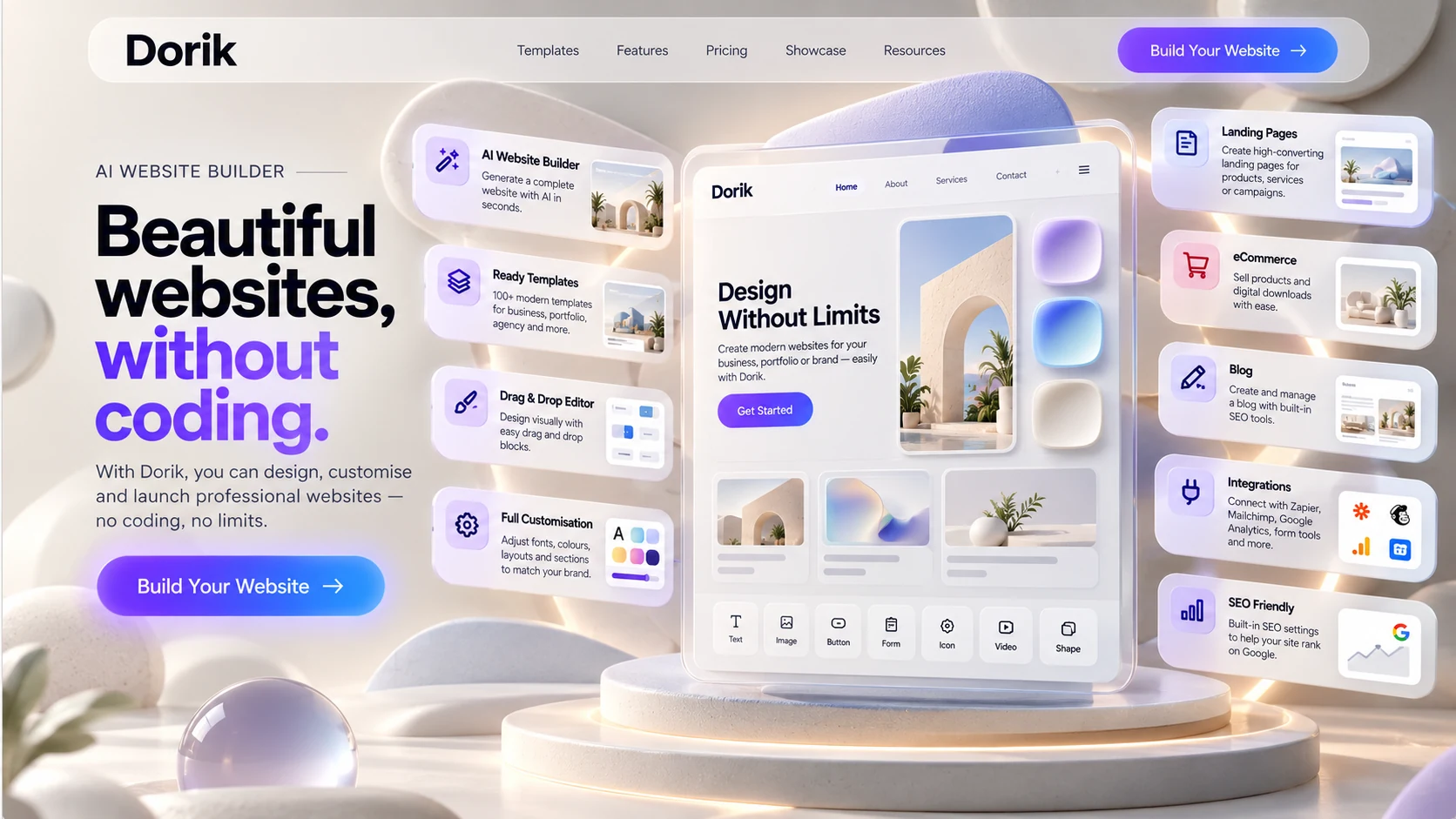
Describe your site, get an AI-generated multi-page draft, then refine it with a no-code visual builder. This review covers what Dorik's AI tools actually do, current pricing across its billing options, export and portability limits, what G2 reviewers say, and who gets real value from it.
Pricing and features can change. Check Dorik's current pricing page before you subscribe.
Dorik is an AI-powered, no-code website builder. Describe your site in a sentence and Dorik generates a multi-page draft, including copy, images, and structure. Dorik advertises this as typically taking under a minute. From there, a drag-and-drop editor lets you adjust every section without writing code. It includes built-in hosting and a CMS with collaborator access.
Dorik combines AI-generated layouts, a visual editor, and built-in hosting. You can build and publish a website without setting up separate hosting. The trade-off is flexibility: Dorik's site-building engine is not portable to another host. Before choosing Dorik for a long-term project, weigh the limits on customization, integrations, and exporting a complete website to another platform, covered later in this review.
Dorik's documented workflow lets you start with a template or generate a draft with AI, edit it in the visual builder, connect a custom domain, and publish. Hosting is included, so a separate hosting account is not required.
Two videos from Dorik's own official YouTube channel accompany this review: the AI-generation launch, and a walkthrough of core builder basics.
Streamed live Jan 4, 2024 - Dorik's own launch walkthrough of its AI website-generation feature.
Uploaded Jul 20, 2022 - a walkthrough of the core visual-editor workflow for building a site in Dorik.
Dorik's AI tools cover four areas, according to Dorik's own product pages:
Describe your business and Dorik generates a multi-page site draft with layouts, text, and images.
Generates headings, paragraphs, calls to action, and metadata in a chosen tone, and can rewrite selected text in place.
Generates visuals from a text description inside the builder.
Suggests color palettes and font pairings that can be applied site-wide.
These tools can reduce the work needed to produce a first draft. They do not remove the need to review the result: check the generated copy, replace any unsuitable images, verify business details, and test how pages look on mobile before publishing. AI usage limits may depend on your plan. Check Dorik's current plan details if you expect to generate many sites, images, or text variations.
Available agency features depend on the plan, and not every feature below is confirmed to be available on every tier. Dorik's help documentation identifies client billing as an Agency-plan feature, while its pricing page lists client billing among the features shown for Personal, Business, and Agency subscription cards. Dorik's own sources do not agree on this point, so confirm current plan details directly with Dorik before choosing a plan for client work.
Dorik can display Airtable data inside a website using table, grid, or job-board layouts, with search and filtering. This is useful for building a directory, job board, event calendar, or product listing without manually recreating every record on the site.
Dorik advertises real-time synchronization between Airtable and the published site. If your workflow depends on updates appearing immediately, confirm the sync behavior and any relevant limits before relying on it.
Dorik's blog includes per-post SEO controls: meta titles, descriptions, custom slugs, canonical URLs, and sitemaps, with schema markup and a robots.txt editor available on higher plans. These controls help manage how pages are described to search engines and crawlers. They do not by themselves guarantee indexing or rankings, which also depend on content quality and site structure.
Dorik supports gated content and paid memberships with three access levels: Public, Members Only, and Paid Members. Its payment integrations include Stripe, PayPal, Gumroad, and Paddle, though the payment options available for a specific membership setup may differ by provider. Dorik advertises zero platform commission on membership revenue; standard payment-processor fees may still apply.
Dorik also supports importing existing posts from WordPress, Ghost, Medium, and Substack.
Dorik's native membership and payment features are not a complete ecommerce system. For a product store, Dorik supports integrations such as Shopify Buy Buttons and an embedded Ecwid store, each with its own features and pricing: Shopify adds buy buttons with Shopify-run cart and checkout, while Ecwid embeds a full store with its own cart, checkout, and multi-channel inventory sync. Check either provider's own pricing and features before choosing this setup.
This is a qualitative guide, not a ranking. Each product's features and pricing change, so confirm current details directly before deciding.
| Tool | Main Strength | Consider It When | Starting Price (USD) |
|---|---|---|---|
| Dorik | AI-assisted website creation, built-in hosting and CMS | You want a no-code site and a simple publishing workflow | $29/mo (Personal, monthly billing) |
| Webflow | Detailed visual design controls and a structured CMS | You need more control over layouts, content structure, or custom interactions | Free (Starter); $15/mo (Basic, annual billing) |
| Framer | Design-focused site building and visual effects | You are building a portfolio or marketing site where visual presentation is central | Free; $10/mo (Basic, annual billing) |
| Durable | AI website creation with built-in CRM and invoicing | You want a website alongside tools for managing leads and invoices | Free option; confirm current paid pricing directly with Durable before comparing |
Checked directly on Dorik's pricing page, October 10, 2026. Prices are USD and depend on the billing period you choose. Discounted and lifetime offers shown below are not guaranteed to remain available at these terms indefinitely.
$20.75/mo billed annually ($249/yr); $10.38/mo billed every 2 years ($249 total).
$41.50/mo billed annually ($498/yr); $20.75/mo billed every 2 years ($498 total).
$79/mo billed annually ($948/yr); 2-year billing by contacting Dorik.
Lifetime, one-time-payment options are also listed separately: $249 for Personal (one site), $599 for Business (three sites).
Dorik also advertises a 7-day free trial with full access, limited by whichever plan's website limits apply during the trial.
Under the two-year billing option, Dorik displays a card labeled "FREE" alongside a $10.38/month price and a $249 upfront charge. Because the label and displayed charge conflict, confirm the offer and plan name directly with Dorik before purchasing.
Dorik's pricing page and help documentation do not present every plan feature consistently. Confirm code-export eligibility and agency-feature limits directly with Dorik before choosing a plan.
| Export type | What it does | Main restriction |
|---|---|---|
| HTML/CSS/JS files | Exports static-site files for use outside Dorik | Static sites only; Dorik's pricing page and export documentation list different plan restrictions, so confirm eligibility directly before relying on this |
| JSON | Transfers supported site structure into another Dorik site | Static sites only; CMS content and pages are not included when importing static pages into a CMS site |
HTML/CSS/JavaScript export is intended for taking a static site's files outside Dorik. If you move those files to another host, forms, analytics, and third-party integrations may need to be configured again, and the files cannot be re-imported into Dorik. JSON export serves a different purpose: it transfers supported site structure into another Dorik site, not to another platform.
These options do not provide a complete migration path for a CMS-powered site. JSON export transfers supported site structure between Dorik sites, while code export is limited to static sites.
Dorik includes hosting, so a separate hosting provider isn't required to publish. That simplifies setup, particularly for beginners.
Built-in hosting does not by itself guarantee fast page loads. Load times depend on the images, fonts, scripts, and other elements used on a given site. If performance matters for your project, test the published site directly with a tool such as PageSpeed Insights rather than relying on architecture claims alone.
Want to go from no website to a live one with minimal setup and no coding.
Need a clean, professional-looking site quickly, without building a complex system around it.
Value speed and want a CMS a collaborator can use without full builder access.
Dorik may be a weaker fit if you need highly customized designs, complex app features, specialized integrations, or a way to move your site without losing important functionality. Check the available features, plan limits, and export options against your requirements before committing.
Pick something else if you need granular control over layout and logic (Webflow or WordPress fit that better); if you depend on complex integrations or an API-driven backend; if you are planning a large content operation with hundreds of pages; or if you are committing a client's long-term project to a platform without first confirming how portable it is.



G2 lists Dorik at 4.6 out of 5 based on 255 reviews, as of G2's page metadata dated September 28, 2026.
What Users Love
Top Concerns
Ratings may change as new reviews are added.
This TechScribe review draws on Dorik's official product pages and help documentation, along with third-party sources such as G2. Feature and pricing details were checked against published sources available on October 10, 2026. This page contains affiliate links; if you sign up through one, TechScribe may earn a commission at no extra cost to you. That relationship has no bearing on the findings above.
Launching a website quickly: landing pages, portfolios, personal brand sites, and small business sites where getting live fast matters more than deep customization.
Dorik advertises a 7-day free trial. Its pricing page also displays a confusing "FREE" label alongside a $249 upfront charge under the two-year billing option. See the pricing section above and confirm the current offer directly with Dorik before purchasing.
Portability. Dorik's engine is not portable to another host, and exporting a site covers only specific formats with restrictions by plan and site type, covered in the export section above.
Dorik is designed to reduce setup work and gets you live faster. WordPress offers more flexibility and a larger plugin ecosystem, which can mean more configuration.
On eligible plans, yes. Collaborator access lets you give someone content-editing permissions without granting full builder access. Personal includes no collaborators, Business includes 10, and Agency is unlimited.
Yes, with Public, Members Only, and Paid Members access levels, and payment integrations including Stripe, PayPal, Gumroad, and Paddle at zero Dorik commission. It supports importing existing posts from WordPress, Ghost, Medium, and Substack. Dorik's native membership tools are not a full ecommerce platform. For a product store, it supports integrations such as Shopify Buy Buttons and an embedded Ecwid store, each with its own features and pricing.
Yes. Dorik offers a white-label CMS and role-based access for client teams, though not every agency feature is confirmed available on every plan. Client-billing availability should be confirmed directly with Dorik, since its help documentation and pricing page do not present the plan restriction consistently.
Dorik is built for people who want to launch a website quickly. AI generation, a visual editor, built-in hosting, and CMS tools make that process simpler. The trade-off is flexibility: its export options do not provide a complete migration path for every type of site. If you expect complex requirements or need to move platforms later, compare the alternatives before committing.
Describe your site and see the AI-generated draft, then decide for yourself whether the speed is worth the trade-offs covered in this review.
Independent review. Prices and features may change; always check the official Dorik site for the latest information.
 Dorik
Dorik UseArticle
 Emergent
 Runable