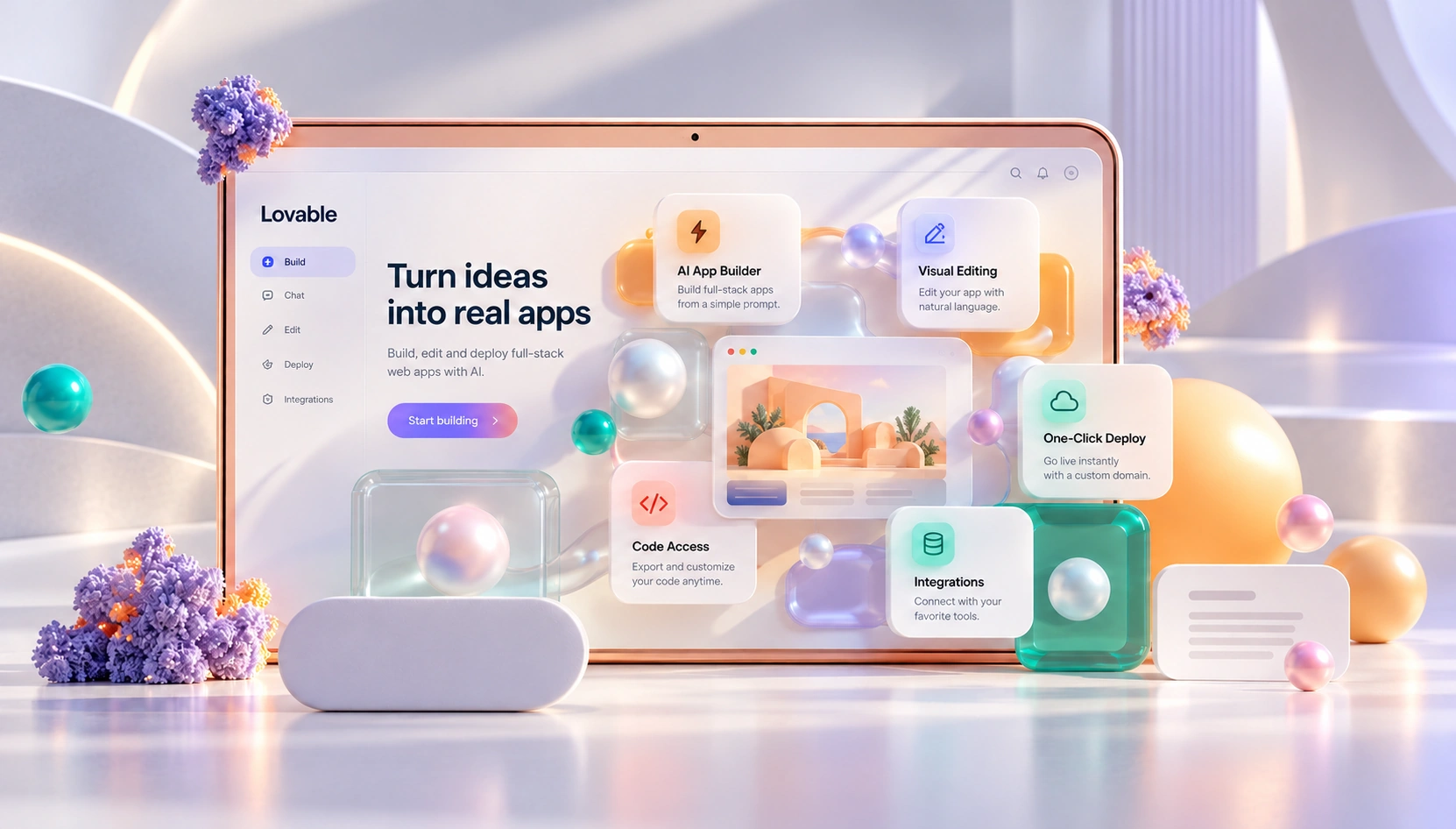
Describe an app in plain English and Lovable builds a working React and TypeScript application, backend included when the project needs one. This review covers real pricing and credits, two 2026 security incidents (explained precisely, not glossed over), GitHub sync limits, Lovable Cloud vs. Supabase, what G2 and Trustpilot reviewers actually say, and who gets real value from it.
Pricing, credits, and features can change. Check Lovable's current pricing page before you subscribe.
Lovable is a tool that turns a plain-English description into a real, working web application. You type what you want, for example "a task list where users can sign up, add tasks, and mark them done", and it builds a React and TypeScript front end, with interactive features, and connects a backend for things like user accounts, a database, and file storage when the project calls for one, plus a live preview you can click through right away.
It is not only a website builder like Dorik or Durable, though it can build marketing pages and landing pages too; it's just not the best tool for that specific job. Its main strength is building interactive applications rather than simple marketing pages: user accounts, data that gets saved, buttons that do something. If what you're building is a simple marketing site, a dedicated website builder will usually be simpler and cheaper. If what you're building needs user logins, a database, or any real behavior, Lovable is built for that.
The code it generates is normal React and TypeScript, the kind of code a human developer could read and work with. There's no made-up format to learn. You can sync your project to a Git repository, and on paid plans you can also download the codebase directly. Either way, that gives you a way to work on the code outside Lovable, but it doesn't include the live database's contents, just the code and the database's migration files (the instructions for its structure, not its records). That said, generated code being standard doesn't automatically mean it's clean, fully tested, or ready for production without review, covered in the security section below.
One technical note, relevant if your site depends on search traffic: since May 13, 2026, new projects are server-side rendered and built on TanStack Start instead of the earlier client-side React/Vite setup, and this happens automatically, with no setup needed on your end. Projects created before that date keep their original client-side architecture for human visitors, but Lovable still pre-renders pages for verified crawlers on older projects too, which makes existing pages easier for search engines and AI crawlers to read. There's currently no self-serve way to upgrade an older project to the new TanStack Start stack; Lovable says it's working on bringing more of the new capabilities to existing projects, but hasn't given a timeline.
"Vibe coding" is the term people use for building software by describing what you want in plain language and letting AI write the actual code, instead of typing it yourself line by line. Lovable is one of the tools most associated with it, alongside others like Replit Agent, Bolt.new, and Cursor.
Lovable has its own page for the term and describes it as "development driven by intent, not syntax": you explain what you want, the AI turns that into working software, and you refine the result by giving it feedback rather than editing code directly. Lovable's own framing targets two kinds of users: non-technical founders who want to build an MVP themselves, and developers who want to skip repetitive setup work and spend their time on harder problems instead.
That framing is Lovable's own marketing, not an independent measurement. Lovable's site claims projects that once took weeks can now take hours; treat that as the company's own claim about its product, not a verified result. What's independently true is narrower: Lovable removes the need to write code yourself for a working first version, and the quality of what you get depends heavily on how clearly you describe what you want (see "Your First Session" below). It does not remove the need to review, test, and understand what gets built before real users depend on it.
You don't need to install anything to start; you open Lovable in a browser and describe what you want built. A few things happen from there:
The first version is never perfect, and that's normal; it's a starting point you keep refining. Getting a backend connected doesn't mean everything is configured correctly out of the box; permissions, data access rules, and testing are still worth checking before real users or real data touch the app.
Four videos from Lovable's own official YouTube channel accompany this review: an intro, a CRM build, an SEO walkthrough, and a Shopify/ecommerce build.
Uploaded Apr 17, 2026, a general introduction to building with Lovable. (Lovable, official channel)
Uploaded Jun 16, 2026, a walkthrough of building a CRM-style app end to end. (Lovable, official channel)
Uploaded Jun 3, 2026, a walkthrough focused on SEO for Lovable-built sites. (Lovable, official channel)
Uploaded Oct 22, 2025, a walkthrough of building an ecommerce app connected to Shopify. (Lovable, official channel)
Not a mockup, something a person can actually log into and use.
You describe what you want in plain language. You don't need to know React or SQL to get a working first draft.
When you ask for a change, Lovable updates the existing app instead of generating a brand new one each time. Changes add up instead of resetting your progress.
Lovable can set up a database and login system (via Lovable Cloud) as part of building your app, rather than requiring a separate setup step later, though the exact backend behavior depends on your workspace settings.
Because the code is plain React and TypeScript, a developer who inherits the project can read it without learning a custom system first, though they should still review the architecture and logic before building on it.
Admin panels, simple dashboards, internal forms, things a team needs but a developer never has time to build, are a good fit here.
Lovable's backend comes in two forms, and which one you're using changes what you're actually paying for and how it's configured:
If a feature you ask for needs backend functionality (login, file storage, etc.), Lovable either turns on Cloud automatically or asks you first, depending on a workspace permission setting. On some Enterprise workspaces, an admin can turn Cloud off entirely.
Lovable gets you to a working app fast, which makes it easy to forget that "working" and "safe to put real user data into" aren't the same thing.
A real security incident happened in 2026, and it's worth describing precisely. Here's what Lovable's own incident report says, not a secondhand summary of it:
The practical lesson is to understand the difference between project visibility and website access; Lovable itself describes these as two independent settings. Project visibility controls who can see your project in the Lovable editor (code, chat history, everything). Website access controls who can visit your published app at its live URL. Publishing your app does not change who can access it in the editor. During this incident, a flaw in project visibility let outside users reach affected public projects' source code and chat history; Lovable says that flaw is now fixed, and chat history and source code of public projects are no longer accessible to other users. Even so, it's worth checking your project's current visibility setting before sharing it, rather than assuming "making the published website public" and "making the project editor public" are the same thing.
A separate, unrelated vulnerability surfaced in September 2026, this time in TanStack Start itself, not specific to Lovable. Lovable's own security team identified CVE-2026-102989 on September 14, 2026, while examining the libraries that power Lovable apps, and reported it to TanStack's maintainers the same day. A crafted link could get an affected app to run unwanted JavaScript in a visitor's browser, able to reach the visitor's information or act with their permissions in the app, though using TanStack Start alone didn't make every app vulnerable, and not all Lovable projects were affected. While a fix was being prepared upstream, Lovable put firewall protections in place for hosted apps, designed to block exploitation attempts. Lovable says it found no evidence of exploitation in the logs it reviewed. Affected projects get the patched version automatically the next time you make a change, or you can apply the free fix immediately from the project's Security page (no credit cost). If your app is hosted somewhere other than Lovable, these protections don't cover you; you'd need to apply TanStack's own update and redeploy through your own hosting setup. This is a different issue from the April 2026 incident above, with a different cause and a different fix, worth knowing both exist, not conflating them.
More generally, for anything handling real user data: review who can access what in your database (this is usually called row-level security, rules that control which records each user is allowed to see), keep API keys and credentials out of your front-end code, and have an actual human check the generated logic before you launch anything that touches real personal data. Concretely, before launch it's worth checking things like: can one user's account see or edit another user's records, does a failed payment get handled correctly instead of silently marking an order as paid, and do forms and buttons actually work on a phone screen, not just a desktop browser.
On certifications: Lovable states it has a SOC 2 Type II report (SOC 2 is an independent auditor's attestation, not a "certification" in the strict sense, though Lovable's own marketing sometimes uses that word loosely) and holds ISO 27001:2022 certification, and has also announced AIUC-1 certification. None of this automatically makes any individual app built on Lovable compliant with anything. If your project itself needs to meet a specific compliance standard, that depends on how you configure and test your own app, not just which platform you built it on.
How well you describe what you want changes the result. A vague request ("make a dashboard") gets a generic result. A specific one ("a dashboard with a sidebar, a table of user signups with name and email columns, and a button to export to CSV") gets something much closer to what you actually wanted.
Connecting GitHub only creates a new repository; it can't take over one you already have. Confirmed directly against Lovable's own git sync documentation: "You can't import an existing repository into Lovable," and connecting a project "always creates a new repository." A developer can still bring code in manually or work on the project outside Lovable; this is specifically a limit of the automatic sync workflow, not a claim that your existing code can never be involved. (More on GitHub sync below.)
If your workspace runs out of credits, your published pages stay up, but backend and AI features can pause. Confirmed directly against Lovable's own docs: "Running out of credits does not remove your published site," and it keeps loading on its existing URL, since a live site doesn't use credits on its own. What does stop: building, and any AI features in the deployed app. What can pause: features that depend on Lovable Cloud (the backend); the docs say apps relying on the backend or AI features "can pause until credits are available again," and a paused backend sometimes needs a manual "Wake up" after credits are added, rather than resuming on its own. So "my credits ran out" doesn't mean the whole app goes dark; it means the static pages keep serving while anything backend- or AI-dependent may stop responding until you add credits.
Complex, custom logic still needs a developer eventually. Things like detailed payment flows, deep integrations with other systems, or performance tuning at scale are outside what prompting alone handles well. Standard code means a developer can pick it up; it doesn't mean the app is automatically secure, well-architected, or ready to handle real scale without that developer reviewing it first.
The design is functional, not custom. What it builds looks clean and usable by default. A distinctive, designed-from-scratch look takes deliberate iteration on top of that starting point, the same as with any tool.
Lovable can help you build a prototype, an MVP, or a production app, but generating the app and proving it's actually ready for each of those are different things:
Lovable speeds up the first step a lot. What actually determines whether the result is production-ready is testing, security review, monitoring, and maintenance, the same things that determine it for any software, built with Lovable or not. That maintenance doesn't stop at launch, either: dependencies, third-party APIs, authentication providers, and your own app's code can all need updates after you ship, so budget time for that rather than treating launch as the finish line.
Lovable builds web apps; they run in a browser, and they work on phones the way any responsive website does. That is not the same thing as a native iOS or Android app listed in the App Store or Google Play.
To get a Lovable-built app into an app store, you need an extra step, typically wrapping the web app with a tool like Capacitor, either yourself or through a third-party service built for that conversion. This is a standard step for most web-first app builders, not unique to Lovable, but it's easy to miss if you assumed "build an app" meant "automatically get a native mobile app." If app-store distribution matters to your project, plan for that extra step from the start.
Lovable has a toolbar on the live preview with a few ways to make changes without typing a full prompt each time:
Confirmed directly from screenshots of Lovable's own pricing page, October 10, 2026.
Free grants, no paid top-ups.
$21/mo billed annually. 100 monthly credits at this tier.
$42/mo billed annually. 100 monthly credits at this tier.
Talk to sales. Volume-based.
Lovable's pricing page lets you pick a credit amount on Pro and Business plans; 100 monthly credits is the default shown for both.
As of June 2026, Lovable moved to one shared general credit balance that covers both building your app and running it (hosting, database, AI features); previously these were two separate balances. Before any usage draws from that shared balance, specific free grants are applied first, each covering a different kind of activity:
Once the relevant grant is exhausted, that usage falls back to your plan's general credit balance (closest-to-expiry credits get used first). Example build costs Lovable itself gives: changing a button's color is about 0.5 credits, removing a section is about 0.9, adding a login system is about 1.2, and a full landing page with generated images is about 2.0; these are examples of relative cost, not fixed prices.
| Credit type | Expiry | Rolls over? |
|---|---|---|
| Monthly plan credits (monthly billing) | 2 months after issue | Yes, while subscribed |
| Monthly plan credits (annual billing) | 1 month after the annual period ends | Yes, while subscribed |
| Top-up credits | 12 months after purchase | Not stated |
| Daily chat allowance / daily build credits | End of day | No |
| Monthly Cloud/AI grants | End of month (Free) or billing cycle (Pro/Business) | No |
The shared balance is at the workspace level, not per person; on a paid plan with multiple collaborators, everyone draws from the same pool unless per-member credit limits are configured.
What this means for an actively-used app: a small, low-traffic app may be covered by the included monthly Cloud/AI grants alone, depending on its database, storage, and traffic needs. A published app with meaningful traffic or size can use more than those grants provide, drawing from your general balance for hosting and AI usage on an ongoing basis, not just when you're actively editing it. There's no single honest number for "what will this cost me a month"; it depends on usage. The practical move is to watch your actual credit usage in your first week or two on a paid plan, rather than guess.
| Feature | Lovable, current specs |
|---|---|
| Output | Real React and TypeScript code, not a locked-in, made-up format. Standard enough that a developer can read it without an onboarding period, though it should still be reviewed like any handed-off codebase before being treated as production-ready. |
| Backend | Lovable Cloud by default (built on Supabase's open-source foundation), or a separate Supabase project if you connect your own. |
| Hosting | One-click publish to a live web address. Custom domains on paid plans. |
| Version control | Real two-way GitHub sync, plus its own built-in undo/version history that doesn't need Git at all. |
| Architecture | New projects since May 13, 2026 are server-side rendered on TanStack Start; older projects keep their original client-side architecture, with crawler pre-rendering added for both. |
| Scaling | Built on standard React and Postgres, so developers can apply familiar tools and techniques to improve performance as the app grows. Standard technology doesn't guarantee good performance on its own; the actual result still depends on how the app is built and hosted. |
G2 shows Lovable at 4.6 out of 5 from 451 reviews on its main product page, checked directly on G2 on October 10, 2026. (G2 can show slightly different counts on different pages for the same product; confirm this figure against the specific reviews page you link to before publishing.)
What Users Love (G2)
Top Concerns (G2)
Lovable's Trustpilot page shows a 4.2 out of 5 ("Great") rating from 1,804 reviews, from direct screenshots of Lovable's own Trustpilot page taken October 10, 2026. The star breakdown: 69% five-star, 9% four-star, 2% three-star, 3% two-star, and 17% one-star. Lovable has a paid Trustpilot subscription and actively invites customers to leave reviews (both positive and negative), and replies to 32% of negative reviews, usually within a week.
Trustpilot's own AI-written summary (based on a sample of 926 of the 1,804 total reviews, not all of them) describes a generally positive picture: people say it's simple and intuitive for building working apps and sites without needing to code.
What Users Love (Trustpilot)
Top Concerns (Trustpilot)
One person's experience isn't proof of how the product behaves for everyone, but the 17% one-star share means these aren't rare outliers. Both platforms' overall ratings are solidly positive; the reviews show a meaningful minority of reviewers reporting bad experiences, particularly around credit costs and reaching support. Ratings may change as new reviews are added.
Beyond internal dashboards and admin tools, Lovable commonly connects to real external services, for example Stripe for payments, Shopify for e-commerce, and third-party APIs for whatever data or service a project needs. A service being connectable isn't the same as a complete integration being reliable: payments and external APIs still need testing, correctly scoped permissions, proper error handling, and secure handling of credentials, the same as building the integration by hand would require. A simple API call is a reasonable thing to prompt for; a deep, stateful integration with a complex external system usually still benefits from a developer's involvement.
This compares what's publicly confirmed about each tool, not a ranking of which is "better"; the right one depends on what you're building.
| Best for | Needs a backend? | Free tier | Starting paid price | |
|---|---|---|---|---|
| Dorik | A marketing site or landing page | No | A free plan exists; check current limits before publishing | Varies by plan and billing period |
| Durable | An automated small-business site with built-in CRM | No | Yes, but it's a private preview, not a publicly live site | Launch plan from $22/mo billed annually ($25/mo monthly) |
| Mixo | Testing demand before building anything | No | Yes, genuinely free and publicly live (one page, Mixo branding) | Paid plans add a custom domain, more pages, remove branding |
| Lovable | A working app, accounts, data, real logic | Yes, built in | Yes, $0/mo | $25/mo ($21/mo annual) for Pro |
| Emergent | Building web and mobile apps with AI | Yes, built in | Yes, Free plan, 10 monthly credits | Standard, $20/mo (100 credits) |
Replit and Lovable solve a similar problem with different starting points, confirmed directly against Replit's own pricing page and docs (docs.replit.com, replit.com/pricing).
Replit is a general-purpose cloud coding environment that added an AI agent (Replit Agent) on top. You can write and edit code directly in a real IDE at any point, and the Agent is one way to work, not the only way. Lovable is built the other way around: describing what you want is the default path, and the generated React and TypeScript code is there for you to inspect or export, not the primary interface you work in day to day.
| Plan | Price | What you get |
|---|---|---|
| Starter | Free | A daily Agent allowance, limited monthly cloud credits, basic Agent access, one published app |
| Core | $20/mo ($204/yr billed annually) | $20 in monthly AI credits, full Agent with Plan and Build modes, 1 parallel Agent task, up to 5 collaborators, 7-day database restore |
| Pro | $100/mo (billed annually) | $100 in monthly credits, up to 10 parallel Agent tasks, up to 15 collaborators, 28-day database restore |
| Enterprise | Custom | SSO/SAML, single-tenant environments, custom seat limits |
Replit bills Agent usage with what it calls effort-based pricing. Cost depends on how complex the request is, not a flat per-message rate. Credits on Core reset each billing cycle and don't carry over; unused credits on Pro roll over for two months. Extra credit packs can also be purchased separately.
The practical difference: if you or your team already write code and want an AI agent that works inside a full IDE alongside manual editing, Replit's model fits that. If you want to describe an app in plain language and get a working result without needing to open a code editor at all, Lovable's model is built around that specifically, with a built-in backend (Lovable Cloud) rather than requiring you to wire one up yourself.
You know what you want built and who it's for, but you don't have an engineer yet. Lovable gets you to something real users can try, so you're deciding based on real feedback instead of a guess.
Internal dashboards, admin tools, and one-off forms that would otherwise never get built. Lovable builds them without taking a developer's time.
Lovable can handle the repetitive setup work, logins, basic data screens, so the team's actual developers spend time on the harder, more important parts of the product.
This TechScribe review draws on Lovable's own official docs, blog posts, and pricing page (including direct screenshots), along with G2 and Trustpilot for user sentiment. We checked Lovable's published features, pricing, and security disclosures on October 10, 2026. This page contains affiliate links; if you sign up through one, TechScribe may earn a commission at no extra cost to you. That relationship has no bearing on the findings above.
Building a real, working web app, one with user logins, a database, and actual behavior, without hiring a developer first. The exported code is standard React and TypeScript, so a developer can open it, understand it, and keep building on it without learning a custom format first.
It's real React and TypeScript, the kind of code a developer could work with directly. You can sync it to a Git repository, and on paid plans download it directly; in both cases it stays yours, though neither includes your live database's actual data (just the code and its migration files). "Exportable" doesn't automatically mean "production-ready"; review it like you would any handed-off code.
Lovable Cloud by default, a built-in database, login/auth, and storage, built on Supabase's open-source foundation. You can also connect your own separate Supabase project instead.
Not automatically; connecting GitHub sync always creates a new repository rather than importing an existing one, confirmed directly against Lovable's own documentation. A developer can still bring existing code into the project manually.
Your code stays yours either way. Whether the hosted version keeps running depends on your plan's included credits and usage allowances rather than a subscription switch; a published site stays live even when credits run out, but backend- and AI-dependent features can pause until credits are added.
Yes; Lovable reports a SOC 2 Type II attestation and holds ISO 27001:2022 certification, and has announced AIUC-1 certification. That covers how Lovable runs its own platform; it doesn't automatically make any app built on it compliant with anything specific.
A backend regression (February to April 2026) re-exposed the chat history and source code of projects marked public to other logged-in users. Private projects and Lovable Cloud itself were not affected, per Lovable's own report. It was fixed within two hours of the issue going public on April 20, 2026, though an earlier private report in February had been closed without escalation. Lovable says the flaw was fixed; the incident is a reminder to distinguish project visibility in the editor from access to the published website, and to check both settings before sharing a project.
Not directly; Lovable builds web apps. Getting into an app store needs an extra wrapping step (commonly done with a tool like Capacitor), which is standard for most web-first app builders, not unique to Lovable.
A lot. A specific, detailed description gets a much better result than a vague one, because the app's actual logic depends on what you described, not just its look.
Once real paying users depend on the app, once you need deep integrations or complex payment logic, once architecture decisions start constraining what you can build, or once you're ready to scale and need deliberate decisions about performance and security.
Lovable is for one specific moment: you have an idea for something with real logic behind it, accounts, data, actual behavior, and no developer yet. It gets you from that idea to something real people can try, often the same day, without writing code yourself.
It benefits most the non-technical founder or product manager who needs a real working version to test, not a mockup. The main caveat: "working" isn't the same as "secure and production-ready"; that still takes deliberate review before real user data is involved, the same as any software would need.
Describe the app you want and see a working version appear, then decide for yourself whether it's the right fit against the trade-offs covered in this review.
Independent review. Prices and features may change; always check the official Lovable site for the latest information.
 Dorik
Dorik Durable
 Mixo
Mixo UseArticle
 Emergent
 Lovable
 Runable
 Carrd
Carrd