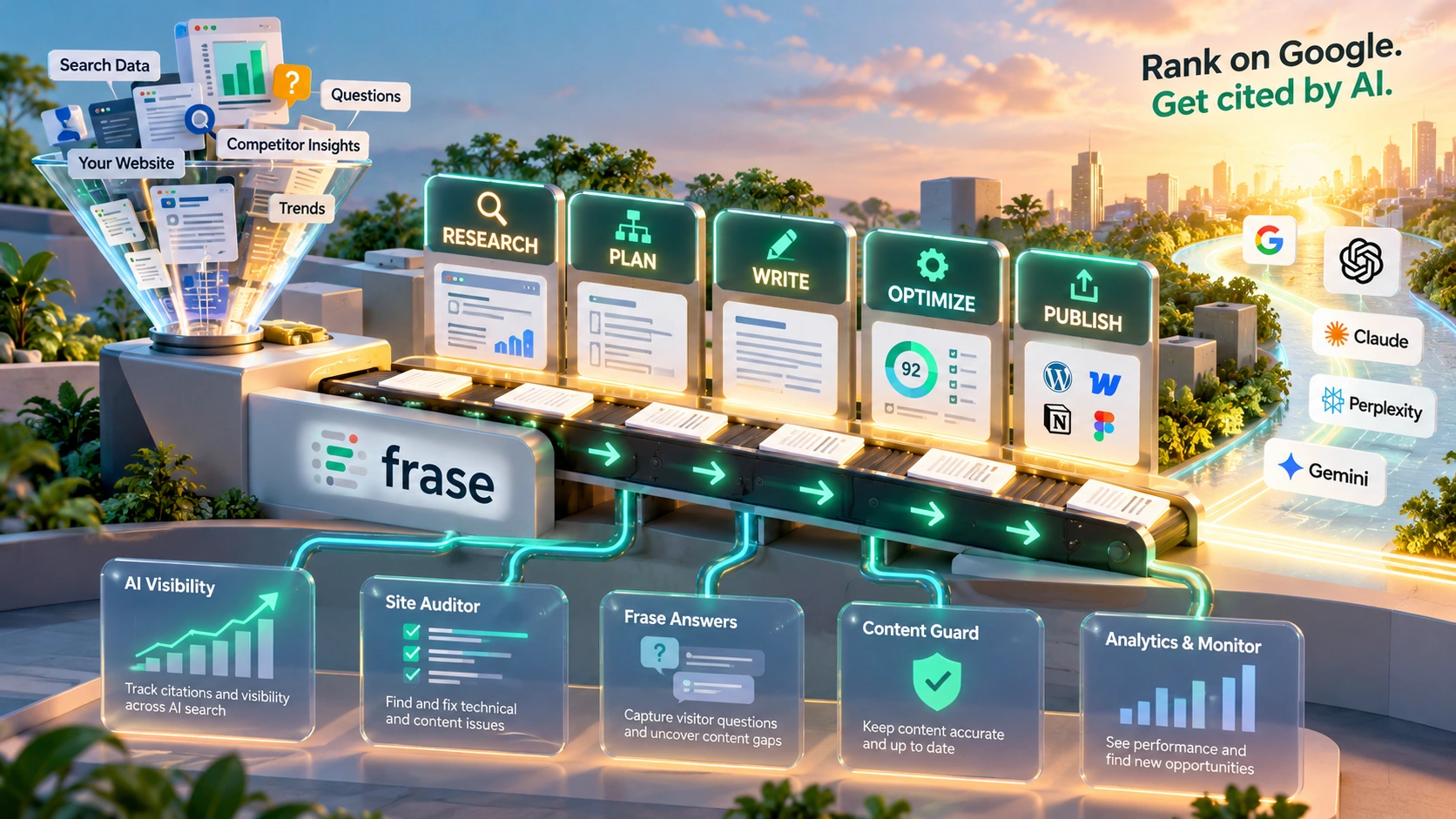
Frase describes itself as "the content operating system for AI search." It started as a content-briefing tool built around one question: what does the SERP expect a piece of content to cover? That core workflow is still there, but Frase now covers much more of the content cycle: site auditing, AI visibility tracking across ChatGPT, Perplexity, Claude, Gemini, and Google AI, AI-assisted writing and publishing, content monitoring through Content Guard, and visitor questions through Frase Answers. This review covers the core workflow, current pricing, what users say on G2, and who actually gets value from it.
Pricing and features can change. Check Frase's current pricing page before you subscribe.
Frase's own positioning is "Rank on Google. Get cited by AI." At its core, it's still a research tool: point it at a keyword, and it analyzes the pages currently ranking, the questions people are asking, and the structure that keeps showing up, then turns that into a brief or a draft.
What's changed is the scope around that core. Frase has added a Site Auditor that crawls your whole site and ranks issues by impact, an AI Visibility tracker built for the AI-search era, a Frase Answers chat widget that answers visitor questions directly from your published content, and an AI Agent that can carry a piece of content from research through to publishing, not just to a brief. The company's own framing has shifted from "build the brief" to "research, write, optimize, publish, and monitor" across one connected platform.
Four official videos from Frase's own YouTube channel, covering the current platform, its Programmatic SEO workflow, the Site Auditor, and AI Visibility.
Feb 2, 2026 - an overview of Frase's current positioning as a content intelligence platform built for both traditional search and AI-generated answers.
Feb 5, 2026 - a walkthrough of the Programmatic SEO feature: finding page families worth building and drafting them at scale.
May 2, 2026 - a demo of the Site Auditor: crawling a site, surfacing technical and content issues, and prioritizing fixes by impact.
May 7, 2026 - a walkthrough of the AI Visibility tracker and the steps it recommends for improving citation rate in AI-generated answers.
The clearest entry point is still Frase's research and briefing workflow:
| SEO Research | Analyzes the pages currently ranking for a target keyword: headings, word count, domain authority, recurring topics, and the questions showing up in "People Also Ask." This is the research layer everything else builds on. |
| Content Briefs | Turns that research into a structured brief: a recommended outline built from competitor headings, questions to answer, a target word count, and a shareable link for handing off to a writer. |
| Topic Clusters | Maps the subtopics around a target keyword by search volume, flags content gaps against your existing pages, and suggests a pillar-and-cluster structure with internal linking opportunities. |
| SEO Content Optimization | Scores your draft in real time against what's currently ranking: topic coverage, missing topics, word count versus the competitive average, and a 0-100 completeness score. |
| Site Auditor | Crawls your site (including JavaScript-rendered pages) and checks three things per page: technical SEO (meta tags, canonicals, headings, broken links, structured data), content quality (thin or decaying pages), and AI readiness (the signals AI engines use when deciding what to cite). It also flags keyword cannibalization across pages and maps orphan pages. Findings are sorted into "Fix now" and "Should fix" by impact; nothing is changed on your live site automatically, you choose what to act on. |
| Backlinks | Finds domains linking to competitors but not to you, and drafts outreach to close the gap. |
Researches a topic, builds a brief, drafts the page in your Brand Voice (a separate setting that trains the agent on your tone from existing content), scores it for both Google-ranking potential and AI-citation potential as you edit, and can publish directly to WordPress, Webflow, Wix, Sanity, or FraseCMS in one click. Auto-publish scope grows with the plan: Starter is draft-only, with every article researched and written for your own review; Professional adds optional auto-publish for FAQs and how-to content specifically; Scale adds optional auto-publish to FraseCMS across all content types. On every plan where it's available, auto-publish is off by default, so a human approval step comes first unless you turn it on.
A chat widget for your site that answers visitor questions using only your published content, and always cites the source page it pulled from rather than inventing an answer. It logs and groups the questions visitors actually ask into content gap signals, and separately surfaces anonymized, industry-level trending questions so you can see what people in your category are asking too, without naming specific competitors. It doesn't publish anything on its own. A free tier is available, with a paid add-on for higher volume.
Scores a draft specifically for AI-answer citation, separate from the Google-ranking score.
Tracks whether and where AI engines cite your pages, classifies tracked prompts by buying stage (awareness, consideration, decision), reports brand mentions and sentiment, benchmarks your citation rate against your industry's median, and supports per-prompt country targeting across 40+ countries. It also monitors AI crawler activity on your site and reports where a cited URL ranks within an AI answer's list of citations, not just whether it was cited at all. Monitoring runs daily with change alerts. AI Visibility is available across the plans, with tracked engines increasing at higher tiers: Starter covers ChatGPT and Google AI, Professional adds Perplexity, and Scale adds Claude and Gemini on top of that. Frase's pricing page lists per-prompt overage rates for Professional and Scale and a 25-prompt cap during the 7-day trial, but as of this check doesn't publish a flat monthly prompt quota for any paid plan, so no specific per-plan prompt number is stated here.
Watches published pages for ranking decay, drafts a fix, and republishes once you approve it.
The setting that controls how much of the above runs without you, within whatever publishing options your plan includes: full manual review, a middle ground where routine changes go through automatically and bigger ones wait for you, or automatic publishing for the content types your plan allows.
Frase's own hosted CMS, described as "agent-ready" (it supports WebMCP, so AI assistants can read and act on pages), free for up to 100,000 page views a month, with paid tiers above that priced at $19/mo and $99/mo. Frase's own CMS feature page doesn't publish the page-view ceiling for those paid tiers, so that detail isn't stated here.
Frase also offers three standalone free tools that don't require a paid plan: a GEO Score Checker, an AI Visibility Checker, and an Agent Readiness Checker.
Current plans, verified directly on frase.io/pricing, checked October 2026:
$39/mo billed yearly.
$103/mo billed yearly.
$239/mo billed yearly.
Quoted by sales.
Annual billing saves 20% versus paying monthly. A 7-day free trial is available on all plans, no credit card required.
Every plan, including Starter, includes CMS publishing (WordPress, Webflow, Sanity, Wix), Google Search Console, imports/exports, Slack notifications, and REST API access with webhooks. There are no separate per-integration fees. Content calendar, internal-linking suggestions, and the Content Opportunities workflow are included from Professional up; Starter doesn't include them.
On refunds: Frase's current Terms of Service state plainly that all fees paid are final and no refunds are offered. The 7-day free trial, not a post-purchase refund window, is the mechanism for evaluating the platform before you commit. Worth knowing going in: Frase itself is explicit that the trial isn't a guarantee either. Its own pricing page states, in effect, that no tool can promise you a ranking or an AI citation inside a 7-day window, and that Frase won't pretend otherwise.
Frase publishes directly to WordPress (no plugin required), Webflow (map your CMS collection once, then publish with one click), Sanity (converts to Portable Text, uploads images to Sanity Assets), and Wix. It pulls performance data from Google Search Console, and imports/exports content as Google Docs or Notion blocks. GitHub and Linear imports cover release notes and issue descriptions. Slack notifications cover content, audit, and alert events. Zapier, Make, and n8n connect through Frase's REST API, which is available on every plan, including Starter, not gated to higher tiers. An MCP server lets you run Frase's research, drafting, optimization, and tracking from inside Claude, ChatGPT, Cursor, Codex, or a terminal; Frase's own integrations page doesn't state a plan requirement for this.
| Strategy depth | High. SERP-driven coverage analysis, built for strategists and content teams, not just solo writers. |
| Research speed | High. Compresses manual SERP research into minutes; audit and AI Visibility checks run automatically. |
| Writing capability | Capable, not just structural. The AI Agent can draft full content in your brand voice and publish directly, though Frase's own default keeps a human approval step before anything goes live. |
| Learning curve | Low to moderate. The interface is straightforward; the real adjustment is working strategy-first rather than writing first. |
| Site audit | Technical SEO, content quality, and AI-readiness checks in one crawl, with cross-site issues like keyword cannibalization and orphan pages flagged separately. |
| AI Visibility | Engine coverage scales by plan: Starter tracks ChatGPT and Google AI, Professional adds Perplexity, Scale adds Claude and Gemini. Includes buying-stage classification, sentiment, industry benchmarking, and citation-position tracking. |
| API access | REST API with webhooks, included on every plan, including Starter. |
| Refund policy | None. All fees are final per Frase's current Terms of Service; the 7-day free trial is the evaluation window instead. |
Frase researches, briefs, drafts, and audits inside one platform. It doesn't replace a dedicated keyword-research and backlink tool like Ahrefs, and Surfer SEO and MarketMuse each go deeper on one specific piece of the workflow than Frase does.
| Capability | Frase | Surfer SEO | MarketMuse |
|---|---|---|---|
| Primary purpose | Research, briefing, drafting, auditing, and AI-citation tracking in one platform | On-page optimization and a dedicated AI-visibility analytics tier | Topic authority modeling across a full content cluster |
| Content briefs | Briefs built from live SERP research, aimed at writer handoff | Briefs available, secondary to its optimization focus | Deep briefs with topic-authority scoring |
| On-page optimization | Real-time content score while writing | A core strength: NLP terms, entity coverage, live SERP benchmarking; higher tiers add internal-linking and cannibalization reports | Present, less granular than Surfer's |
| GEO/AI visibility | A dedicated AI Visibility tracker, engine coverage scaling by plan | A dedicated AI Search Analytics plan tracking brand visibility across ChatGPT, Gemini, and AI Overviews | Not a current focus |
| Site auditing | Built-in Site Auditor with ranked findings | Not a core feature | Not a core feature |
| Starting price | $49/mo, $39/mo billed yearly | $49/mo (Discovery plan); a dedicated AI Search Analytics tier runs $82/mo billed yearly (the monthly equivalent is approximately $95, based on the stated annual savings); top standard tier runs $299/mo | No public price; usage-limited tiers are demo-gated, plus a free tier capped at 10 queries/month |
Choose Frase if you need to: build content briefs backed by live SERP data, audit a site for both technical SEO and AI-readiness issues, track whether AI engines are citing your pages, or move from research to a publishable draft inside one platform.
Choose Surfer SEO instead if you need to: calibrate an already-written draft against live SERP data, with deep NLP and entity-coverage scoring in the editor.
Choose MarketMuse instead if you need to: build topic authority across a large, established content cluster rather than brief and audit individual pieces.
Bottom line: if you want fully automated, hands-off publishing with no review step at all, none of these three are built around that by default. Frase's Autonomy setting supports more automation if you choose it, but its own default keeps a human in the loop.
The interface itself is straightforward: you enter a keyword, review the research pull, and work from the resulting brief or draft. The main learning curve isn't the interface. It's changing from a writing-first workflow to a research-first one, letting the SERP and AI-citation data define what "complete" looks like before you start writing, rather than deciding that yourself and optimizing afterward.
Needs every piece to compete on completeness, not just keyword targeting, and wants the data to set that bar before a writer starts.
Needs a concrete brief rather than a vague assignment, and benefits from a tool that removes the guesswork of what to cover.
Needs standardized briefs across multiple writers, plus a way to audit and monitor dozens or hundreds of pages without manually checking each one.
A different tool may be a better fit in these cases:




Frase has a 4.8/5 rating on G2 from 311 reviews, per G2's product page, checked October 2026. Mention counts on individual themes run low (1-2 mentions each), which is genuinely how G2 displays Frase's review breakdown, not a data error, so treat the ranking of themes as more meaningful than the raw counts.
What Users Love
Top Concerns
G2 ratings and review counts change over time. Check G2's current Frase page for the latest figures before relying on this summary.
Frase is best used for building content briefs backed by live SERP research, auditing a site for technical and AI-readiness issues, and tracking whether AI search engines cite your content. It's built around research and strategy first, writing second.
Starter is $49/mo ($39/mo billed yearly), Professional is $129/mo ($103/mo yearly), Scale is $299/mo ($239/mo yearly), and Enterprise is custom-priced. Annual billing saves 20%. A 7-day free trial is available on every plan, no credit card required. Per Frase's pricing page, checked October 2026.
No. Frase's current Terms of Service state that all fees paid are final and no refunds are provided. Use the 7-day free trial to evaluate the platform before committing.
On Professional and Scale, yes, optionally, and it's off by default. Starter is draft-only: the agent researches, drafts, and scores every article for your review, with no auto-publish option. Professional adds optional auto-publish for FAQs and how-to content; Scale adds optional auto-publish to FraseCMS across all content types. Wherever auto-publish exists, Frase's Autonomy setting controls it, and a human approval step comes first unless you turn it on.
ChatGPT, Perplexity, Claude, Gemini, and Google AI, per Frase's current AI Visibility feature page.
Yes, and no plugin is required. Frase also publishes natively to Webflow, Sanity, and Wix, pulls data from Google Search Console, imports/exports with Google Docs and Notion, and connects to Zapier, Make, and n8n through its REST API, which is included on every plan.
They solve different parts of the workflow. Frase researches and builds the brief, and can now draft and audit as well. Surfer SEO is stronger when the primary job is optimizing content against SERP and on-page signals, while its separate AI Search Analytics product handles AI visibility.
Skip Frase if you want a dedicated keyword-research or backlink-analysis tool as your primary need, want a pure on-page optimization tool for drafts you've already written, or want a fully hands-off publishing workflow with no review step built in by default.
Frase has grown from a content-briefing tool into a broader SEO and AI-search content platform: research, a site auditor, an AI agent that can draft and publish, and an AI Visibility tracker built for the shift toward AI-generated search answers. The core idea hasn't changed: define what a piece of content needs to cover before you write it. What's changed is how much of the rest of the pipeline, auditing, drafting, publishing, and monitoring for AI citation, now sits inside the same platform.
The strongest case for Frase is a content team that wants research, briefing, drafting, auditing, and AI-citation tracking under one roof, and is willing to let SERP and AI-citation data set the bar for what "done" looks like. Buying it mainly for keyword discovery or backlink analysis is a weaker fit; a dedicated tool is a better primary choice for that layer, with Frase's own research and briefing layered on top.
Pick a keyword you're planning to target, run it through Frase's research pull, and compare the resulting brief against what you would have written from a blank page.
Independent review. Prices and features may change; always check the official Frase site for the latest information.
 Frase
Frase