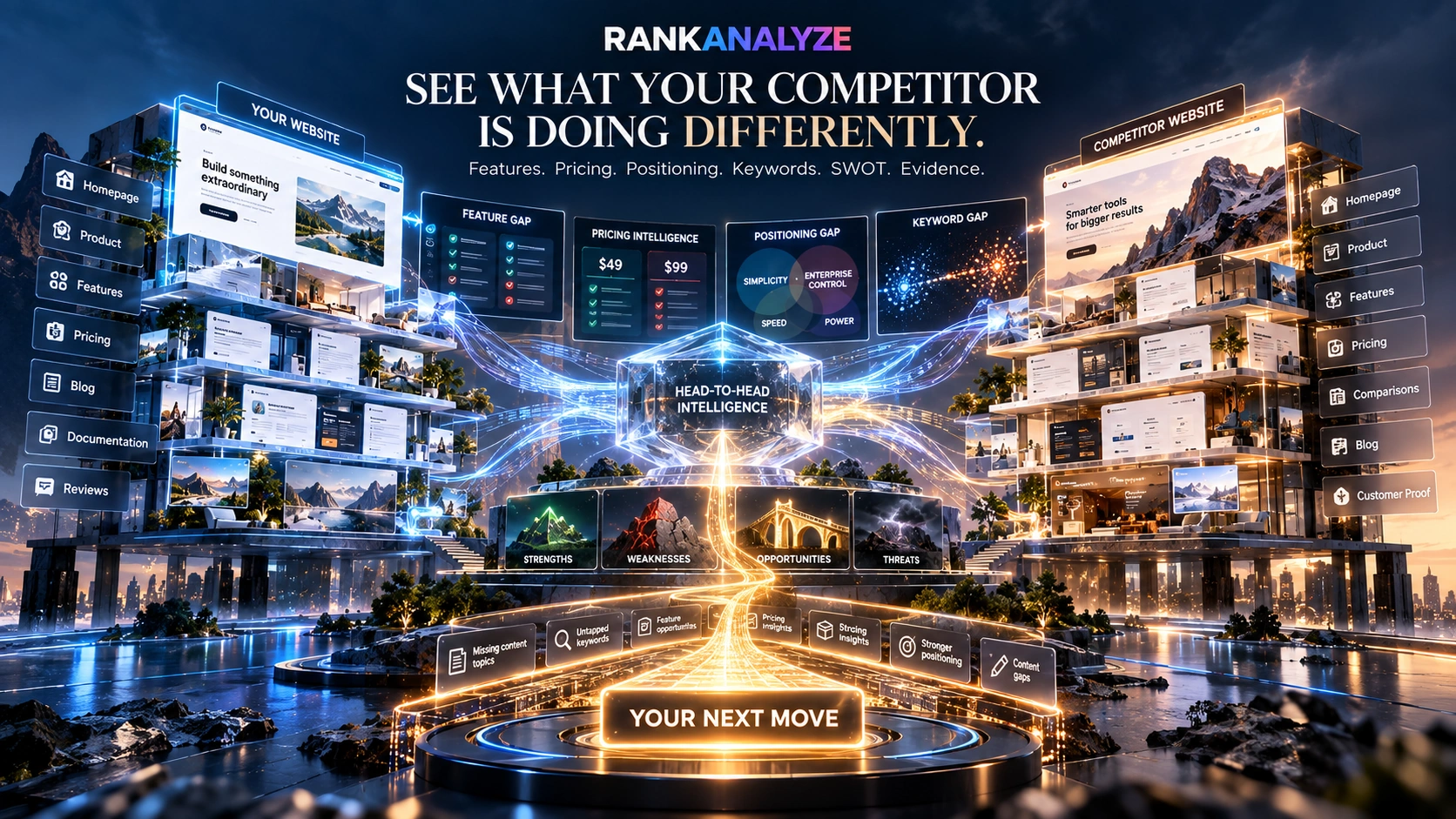
You already know who your competitors are. The hard part is knowing why a visitor picks their page over yours.
Most teams answer that by opening ten browser tabs and filling in a spreadsheet. It takes an afternoon. A month later the competitor changes their pricing page and the spreadsheet is out of date.
RankAnalyze is a competitor analysis tool built for that problem. It shows you where your product stands against a specific competitor, not just a rough estimate of their traffic.
This post focuses on Head-to-Head, a workflow that compares your product with one competitor. It reads the pages where each company explains its offer, including pricing, features and related pages. It finds the gaps in messaging, features, pricing, proof and keywords, then turns them into a Competitive Gap Index from 0 to 100.
Competitor Radar works alongside it. It watches a competitor's pricing and feature pages and alerts you when something changes. That keeps your Head-to-Head findings up to date, instead of relying on a snapshot that quickly goes stale.
To show what a real report looks like, we ran Head-to-Head between a mid-sized AI tools review site and one of the biggest AI tool directories online. We'll walk through the real results, explain each part, and compare the tool with Semrush and SE Ranking.
Head-to-Head is one of eight workflows inside RankAnalyze. See the full RankAnalyze review for the other seven: Ranking Audit, Brand Deep Dive, Post-Publish Audit, Competitor Radar, GEO Scan, Asset Audit, and Rank Tracker.
Search itself is changing. Google's AI Overviews and tools like ChatGPT increasingly answer a question directly, citing one or two sources along the way instead of showing ten blue links. If a competitor's page makes a clearer case, on the page itself or in how an AI summarizes it, that's who gets picked and who gets cited.
Staying ahead in that environment isn't a one-time task. It means checking the comparison again after a competitor changes their pricing, adds a feature, or shifts their messaging to target a new use case. A page that beat the competition six months ago can lose that edge without a single word changing on your side, simply because theirs did.
Most competitor analysis tools, Semrush and SE Ranking included, are built for domain-level research: how much traffic a competitor gets, which keywords bring it in, who links to them. That's useful for spotting where they're strong overall, but it doesn't answer what a visitor actually sees the moment they land on a specific page, or why they'd pick that page over yours. That's the gap Head-to-Head is built to close.
Where it actually helps: before a pricing change, before a relaunch, or whenever your sales team needs a straight answer to "why would someone choose them over us?" It's why we're walking through a real report below instead of just describing the feature.
A good competitor analysis answers one question: why does someone choose them instead of you? (If you want a simple way to set that up, here's a simple competitor analysis framework.)
The problem is doing it by hand. You have to read both pages line by line, note every feature, copy down their prices, compare headlines, and check what proof they show, like reviews or case studies. Then you have to do it again every time something changes.
So most teams do it once, at launch, and never again.
Before picking a tool, decide what you're trying to compare. There are two very different jobs:
Tools like Semrush and SE Ranking are built for the first job, and they go deep on it: full backlink gaps, domain-wide keyword data, ad intelligence. RankAnalyze Head-to-Head covers both in one run. Its core is the product-to-product comparison, but every report also includes a backlink summary, product-scoped keyword gaps with real search volume, and a full SWOT and competitor profile built from what both sides actually say, something neither Semrush nor SE Ranking does. Most teams still keep a dedicated domain tool for the deeper, domain-wide backlink and keyword work, but for anything specific to one product, Head-to-Head already has it covered. (For a wider look at what each type of tool does, see this breakdown of SEO tools and which you actually need.)
Head-to-Head is one of the workflows inside RankAnalyze. You give it your site and one competitor's site. It reads the live pages on both sides, compares them section by section, and gives you a score from 0 to 100 called the Competitive Gap Index (CGI).
That score is built from ten parts of the report, each covering a different angle: an executive summary of how each side positions itself, a feature matrix grading every feature mentioned on either page, a keyword gap listing search terms the competitor ranks for that you don't, a messaging battle checking your page against their strongest claims and proof points, pricing intelligence pulled from the actual prices shown on both sides, a full SWOT, a competitor profile covering their promise, audience, tone and market tier, trust, reviews and site authority signals like Trustpilot ratings, backlinks and page speed, a schema and page structure check, and an AI citation gap showing where the competitor gets cited in AI answers and you don't.
Each run compares one of your products against one competitor's product, not two whole websites. That's on purpose. Comparing your pricing page to their pricing page gives you findings you can act on; comparing two whole domains mostly gives you averages.
The comparison ran a mid-sized AI tools review site against a much larger AI tools directory that lists thousands of tools. Neither site is named here, because the point is the method, not the rivalry.
On paper, it's a mismatch. The directory has over 50,000 backlinks from about 3,900 domains. The smaller site has 15 backlinks from 14 domains.
Head-to-Head gave the smaller site a CGI score of 53 out of 100: "Competitive." Here's how it got there.
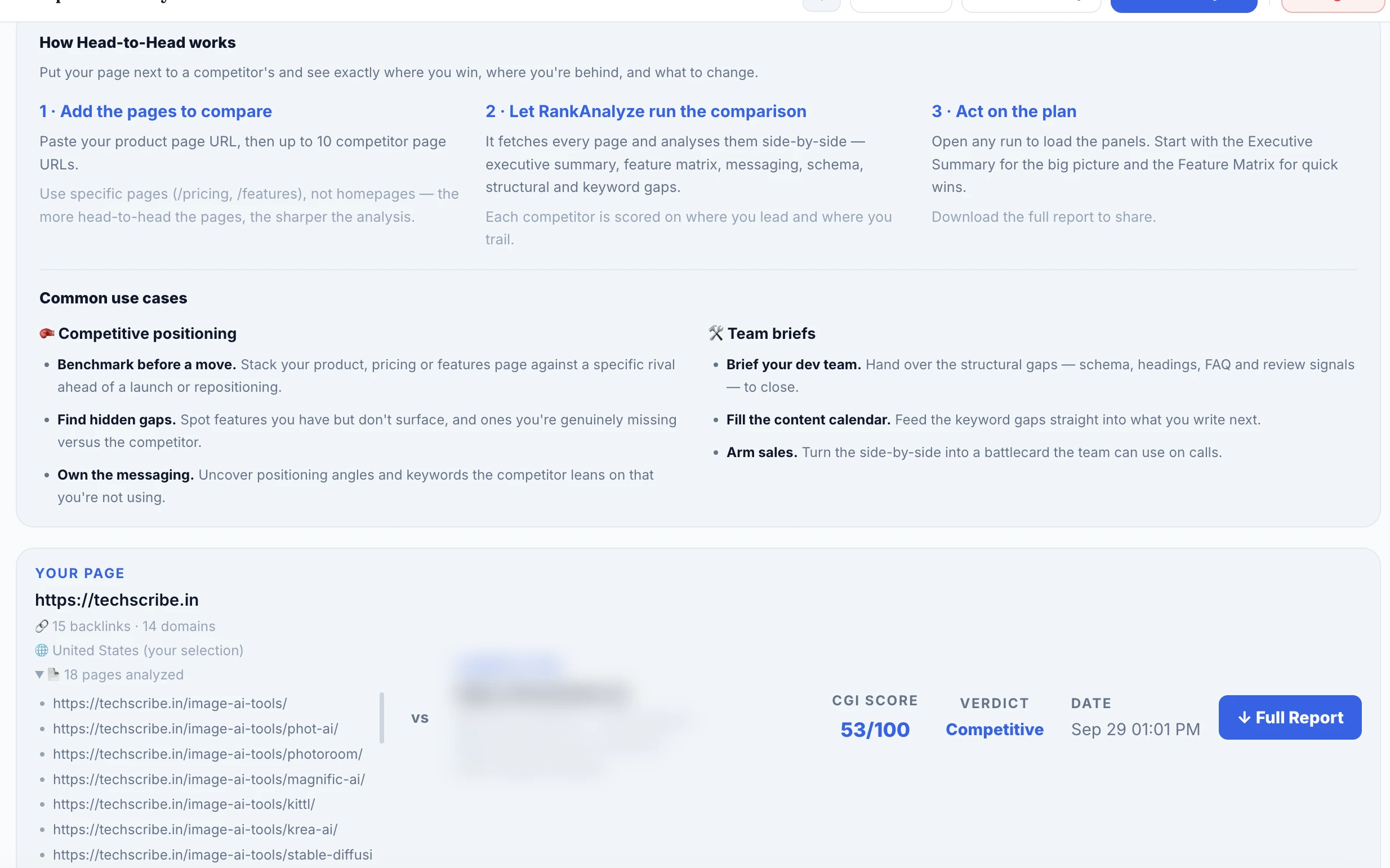
Each section below uses the real results from this test.
The report opens with a short summary of how each side positions itself. The smaller site came across as a hands-on reviewer that tests tools with real workflows and is honest about each tool's limits. The competitor came across as a community-driven database built around search, upvotes, staff picks and a newsletter.
That's useful on its own. It's how a stranger would describe both sites after reading them, and it's a quick check on whether your positioning is landing.
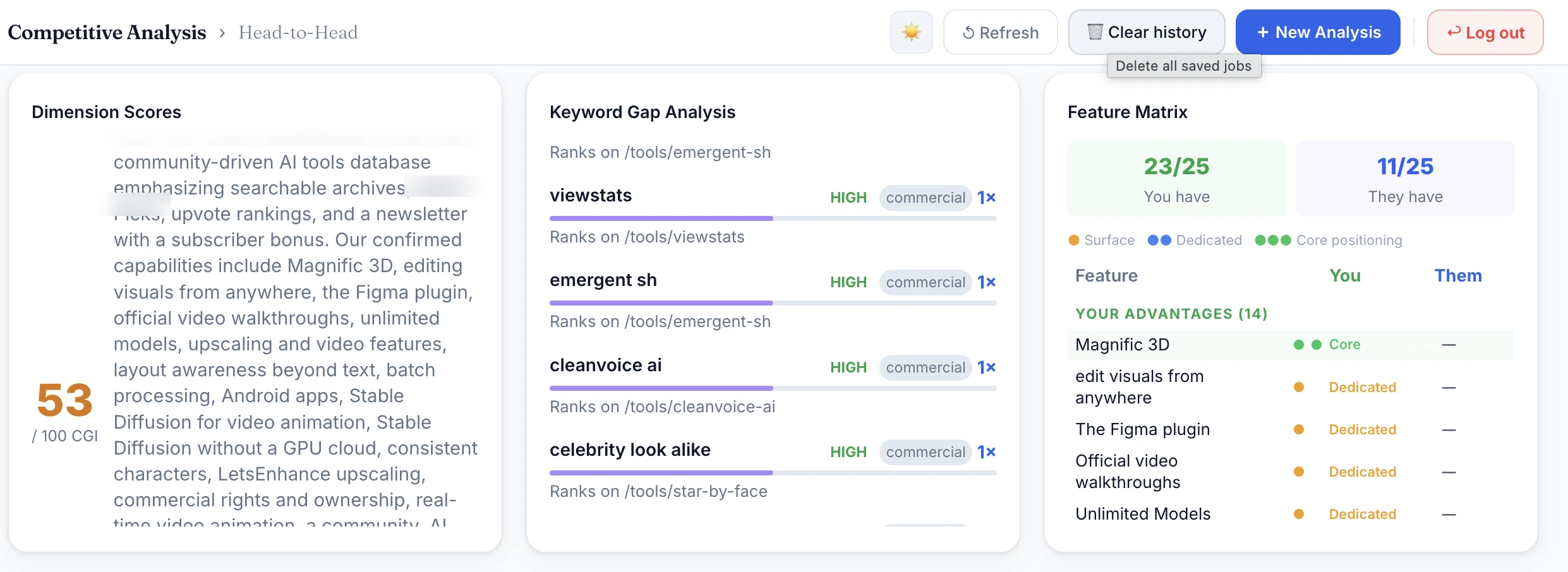
A side-by-side grid of every feature mentioned on either page. In this test, the smaller site showed 23 of 25 features and the competitor showed 11. Its advantages were things like detailed coverage of specific tools and workflows that the competitor's pages don't go into.
Each feature is also marked by how strongly it's covered: a passing mention (surface), its own section (dedicated), or a core part of the page's pitch (core positioning). That tells you which features you actually sell and which ones you just mention.
This lists search terms the competitor's pages rank for that the smaller site doesn't, each with its real search volume, not just the term itself. In this case, it was mostly the names of individual AI tools, such as "cleanvoice ai" and "genmo mochi 1," each with its own listing page on their site.
That's a clear lesson. They win searches for tool names because every tool gets its own page. You can feed a list like this straight into your keyword research and content plan.
This section lists the features, phrases, trust signals and FAQ topics the competitor puts front and center, and checks each one against your page. You get two lists: what you already cover, and what you could add.
For the smaller site, it found that the competitor leans on AI detection and automation tools, a trust claim of "50,000+ companies," and a long list of niche use cases. It also confirmed what was already covered well.
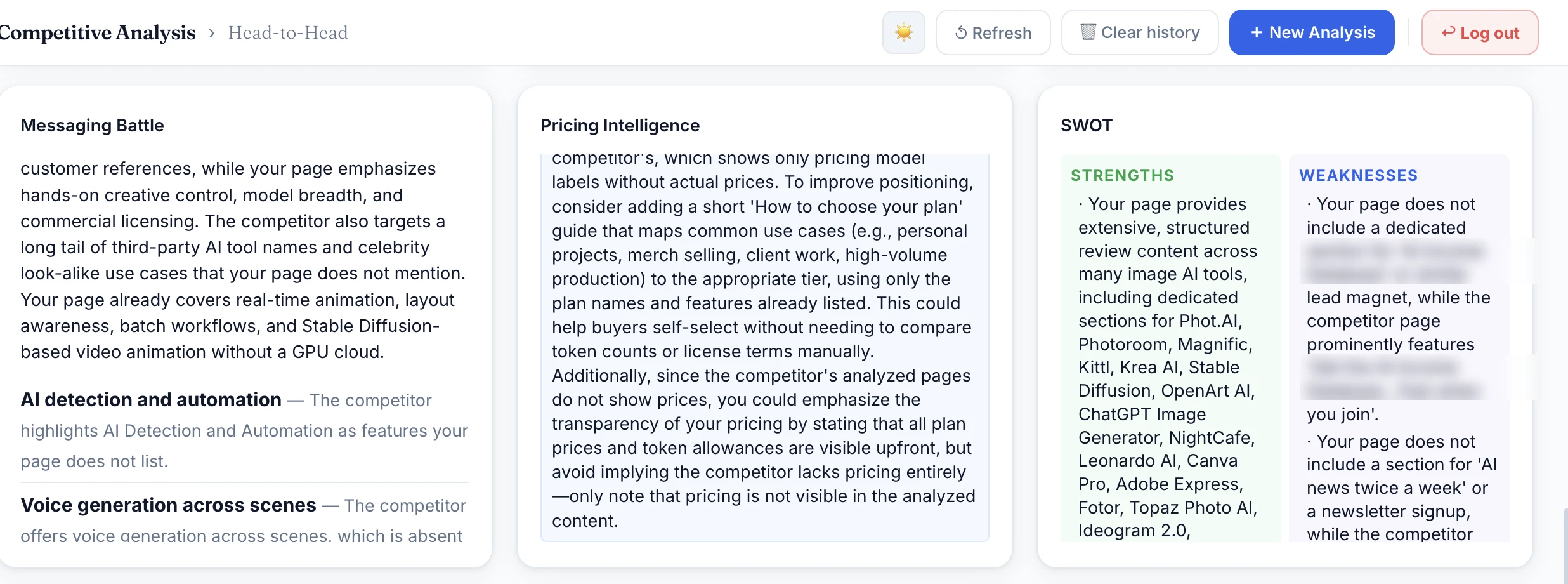
Head-to-Head pulls the actual prices shown on both sides. In this test, the competitor's pages showed pricing labels like "free" or "paid" but no actual prices. The report suggested adding a short "how to choose a plan" guide that matches common use cases to the right tier.
It was also careful with its wording. It phrased pricing as "not visible in the analyzed content," rather than claiming the competitor has no pricing. That's the kind of detail that keeps a comparison honest.
Pricing is also the thing competitors change most often. A one-time comparison won't catch that, so it's worth setting up a way to track when a competitor changes positioning or pricing.
A full SWOT (strengths, weaknesses, opportunities, threats) built from what the two sites actually say.
Its strength: detailed, structured reviews of dozens of named tools. Its weaknesses were specific and fair. The competitor offers a free bonus for joining its newsletter, and sends AI news twice a week. The smaller site had neither a lead magnet nor a newsletter signup, two easy fixes.
A short profile built from the competitor's own pages: their main promise, who they're talking to, their tone of voice, and their market tier. The report summed up the competitor as a "Tier 2 Challenger" with a casual voice, speaking to AI enthusiasts, professionals and creators.
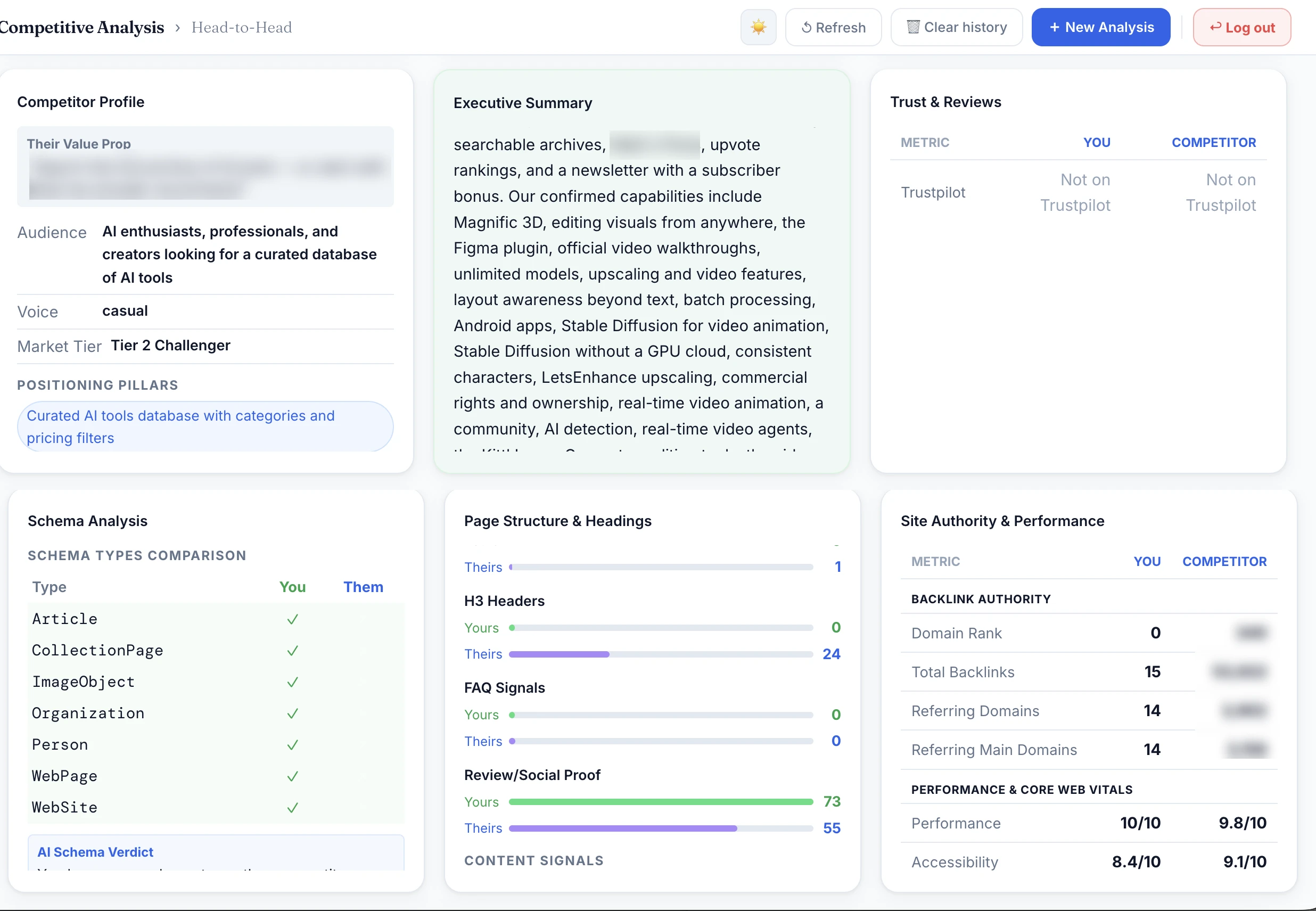
The report compares proof and authority on both sides:
If your page scores low on trust, these landing page audit checks are a good next step.
Schema is code that tells Google what a page is about. The smaller site had seven types of it, including Article, Organization and WebSite. The competitor had none showing on the pages analyzed.
The structure check counts headings and FAQ sections. The smaller site used more main headings (6 against 1). The competitor used far more subheadings (24 against 0). Neither side had FAQ sections, which is an easy win for whoever adds one first.
More people now ask ChatGPT or Google's AI Overviews before they visit a website. When the data is available, the report lists real questions where the competitor gets cited in AI answers and you don't, along with how often each one is asked.
If that list is long, it's worth reading about AI recommending your competitor instead of you and how generative engine optimization works.
At the end, you can download the full report to share with your team.
Three things stood out:
None of this came from traffic estimates. It came from reading both sites side by side, which is exactly what the tool is for.
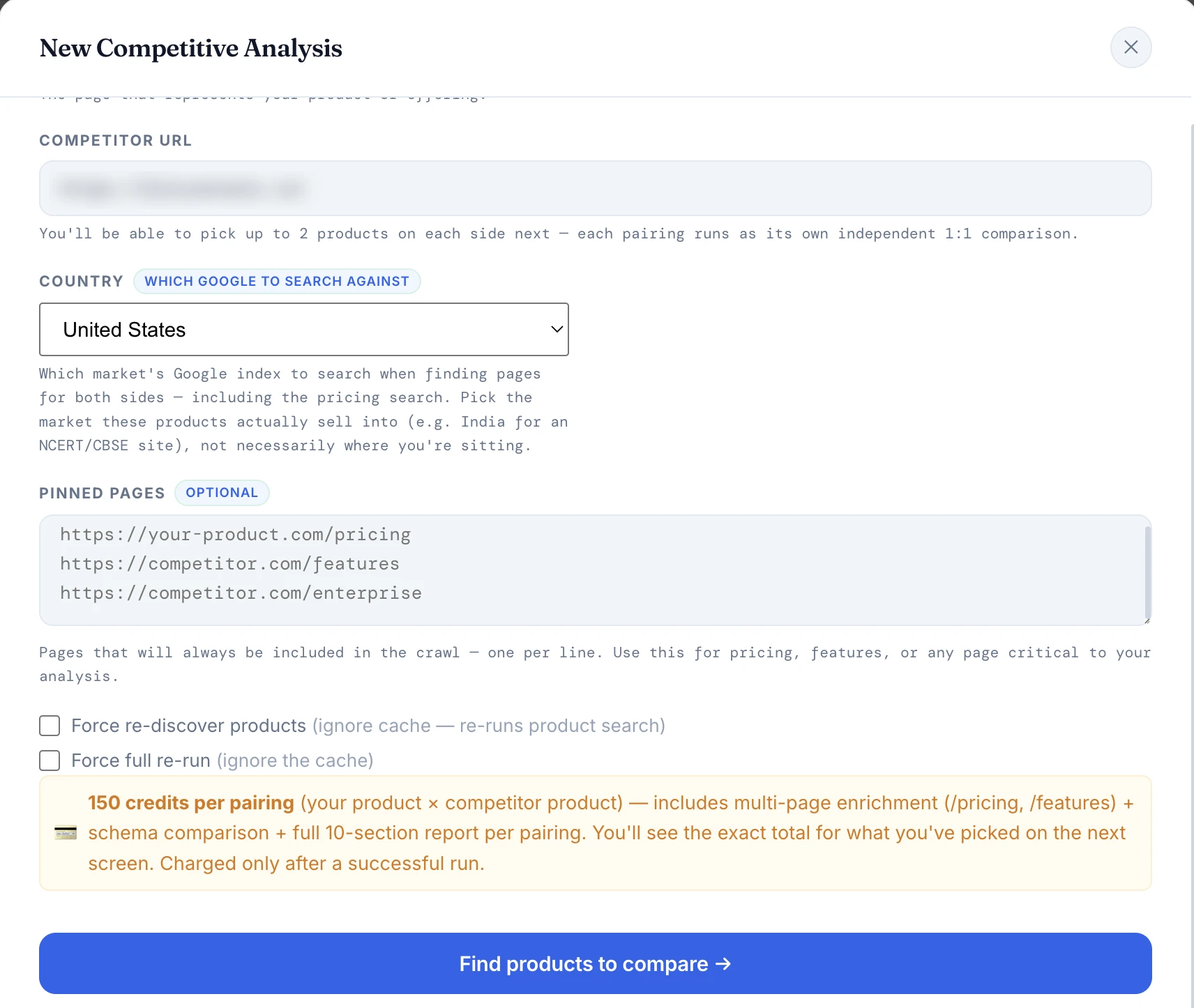
Paste your site and your competitor's site, and pick the country whose Google results to use. Pick the market you actually sell into, not where you're sitting. You can also "pin" pages you always want included, such as a pricing or features page.
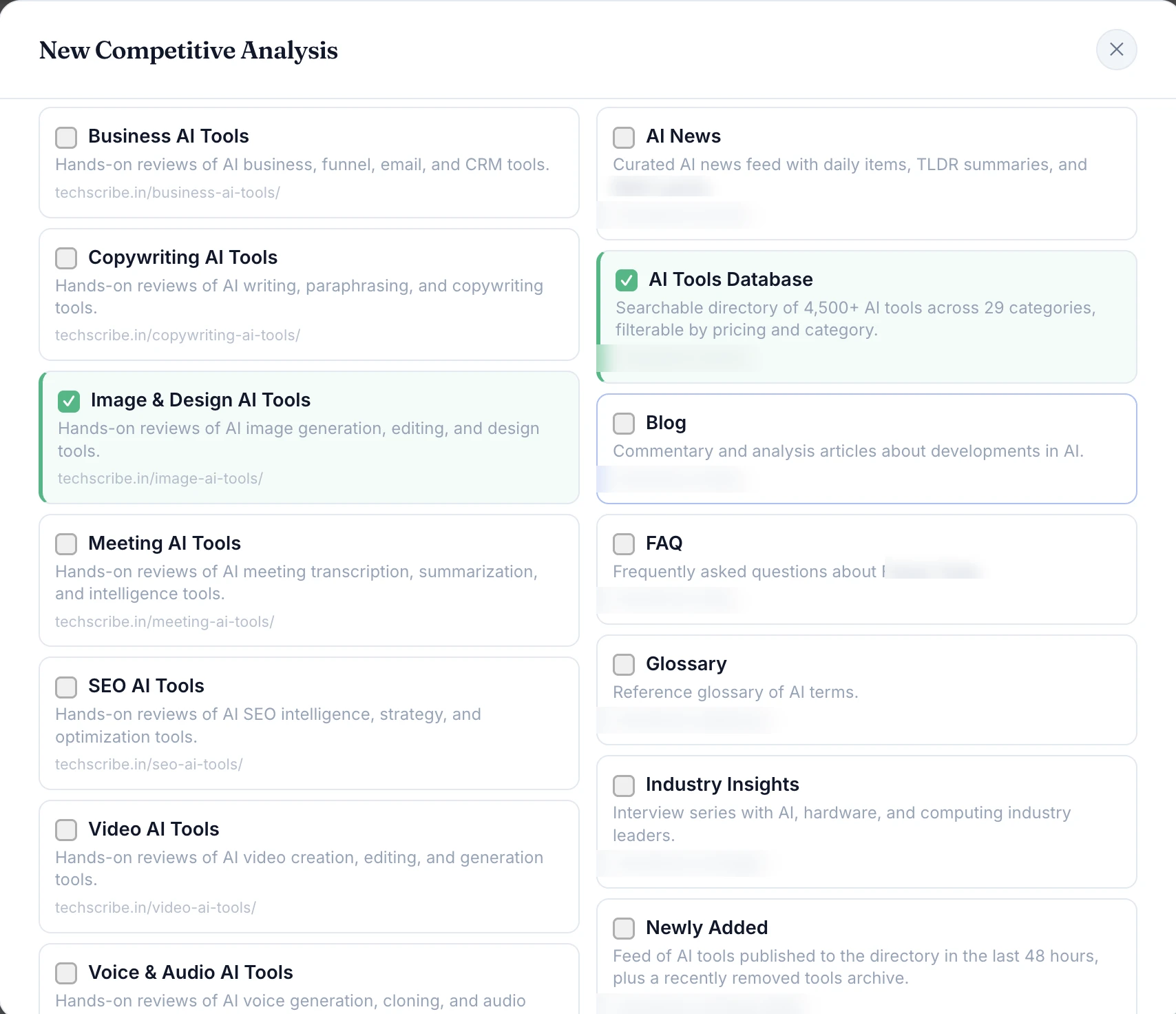
RankAnalyze discovers the individual products or pages it found on each site. Pick up to 2 on your side and up to 2 on the competitor's, each pairing you choose runs as its own separate, independent comparison. This step is free; you're only charged once you actually run a comparison. The closer the two products are in purpose, the sharper the results, so pick like for like, such as their pricing page against yours.
RankAnalyze reads both sides, including related pricing and feature pages, and builds the report. In this test, it analyzed 18 pages on one side and 31 on the other.
Read the executive summary first for the big picture. Then check the feature matrix and messaging battle for quick fixes.
Run a Head-to-Head comparison →
Semrush and SE Ranking are both strong competitor analysis tools. They just answer different questions from Head-to-Head.
| What you want to compare | RankAnalyze Head-to-Head | Semrush | SE Ranking |
|---|---|---|---|
| Level of analysis | One product vs one product | Whole domain | Whole domain |
| Messaging (headlines, selling points) | Yes, side by side from page text | No | No |
| Prices shown on the page | Yes, extracted and compared | No | No |
| Feature-by-feature matrix | Yes | No | No |
| SWOT and competitor profile | Yes, built from both sites | No | No |
| Trust signals and reviews | Yes, incl. Trustpilot rating | No | No |
| Keyword gap | Yes, product-scoped, with search volume | Yes, domain-wide | Yes, domain-wide |
| AI citation gap | Yes | Yes (AI Visibility Toolkit, separate add-on) | Yes (SE Visible, separate product) |
| Backlinks | Summary per domain | Full backlink gap | Full backlink gap |
| Page speed | Yes, both sides | Via Site Audit | Via Website Audit |
| Traffic estimates | No | Yes | Yes |
| Ads (copy, spend, paid keywords) | No | Yes | Yes |
| Starting price | $99/month (Starter) | See semrush.com/pricing (7-day free trial) | $52/month (Essential) |
Semrush and SE Ranking tell you how much traffic a competitor gets and where it comes from. Head-to-Head tells you why their page wins the visitor once they land. To see what your own visitors do before they convert, or leave, pair it with customer journey analytics.
If you already pay for Semrush or SE Ranking, Head-to-Head doesn't replace it. It fills the gap those tools leave: what's actually written on the page.
Head-to-Head doesn't look at competitors' ads. You won't see their ad copy, ad spend, paid keywords or ad history. If paid search is where you compete hardest, you'll need a tool like Semrush or SE Ranking alongside it.
Each comparison uses 150 credits, and you're only charged if the run succeeds. Matching the pages (step 2) is free.
Head-to-Head works best as one part of a routine:
If Head-to-Head shows your page is thin, a full content audit is the natural next step. Or see the full RankAnalyze review for how all 8 workflows fit together.
It's software that compares your business with a competitor's so you can see where you're ahead and where you're behind. Some tools compare whole websites (traffic, keywords, backlinks, ads). Others, like Head-to-Head, compare individual pages (messaging, features, pricing, proof).
No. Each Head-to-Head run compares one of your products against one competitor's product. To compare against three competitors, run it three times.
Usually not. Homepages try to say everything at once. Compare pages with the same job, like your pricing page against theirs.
Yes. Both sides are fetched fresh when you run the comparison. Backlink and Trustpilot numbers are stored for up to 30 days because they change slowly.
Yes. In this test, a much smaller site had a huge authority gap against a major directory, and the report still scored it "Competitive" and produced a short list of realistic fixes. A big rival usually wins on links. You can often beat them on content, structure and clarity.
Head-to-Head is a good fit if you already know who your main competitor is and want to know exactly why a visitor might pick them. It's especially useful before a pricing change or a relaunch, or when your sales team needs a battlecard.
It's not the right tool if you mainly want traffic estimates or ad research. Semrush or SE Ranking will serve you better there.
It's an excellent tool once you already have the data and just need to know what to fix next. The score breakdown and CGI charts point straight at the gaps instead of leaving you to dig through numbers, so you spend your time acting on findings, not hunting for them.
For product-level competitor analysis, it saves the afternoon of tabs and spreadsheets. In this test, it produced a list of fixes instead of a pile of notes.
Run a Head-to-Head comparison →
Want the full picture? Read the complete RankAnalyze review: all 8 workflows, pricing, and how it compares to Rank Math, Frase, Ahrefs and Semrush.